A Southern Silk Route - Sikkim and Kalimpong: Wild Flowers and Landscapes
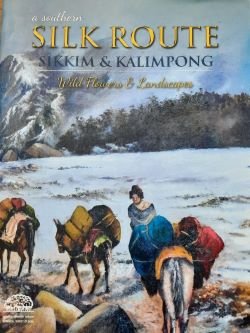
Trade routes entwine the places of production to the places of commerce. The in-demand commodities were usually those that were restricted to certain geographies and therefore, monopolized and these, invariably were at the heart of trade routes. Trade routes also amplitudes the exchanges of culture, religion, ideas and knowledge. Sikkim's centuries old trans-Himalayan trade with its neighbours transformed its socio-economic-political milieu. Tibetan wool was the driver of the Sikkim's trade route along with other important merchandise handled in the trade from Lhasa and vice-versa. The Tea-Horse road trickled down to Sikkim with its coveted merchandise – the tea, which was preferred by the elites as early as 17th century. Lately, these regional overlapping trade routes were assimilated into the larger framework of silk route and Sikkim's trade route is now portrayed as a minor artery of the southern or south-western silk route. This book attempts to encapsulate the evolution of Sikkim from a closed kingdom to a bustling hub of the trans-Himalayan trade all the while understanding the heterarchical influence of the silk route trade, under a botanical theme. A multi-scalar approach is employed in this book to flesh out the interplay between history, culture, geography and nature in the silk route region of Sikkim and Kalimpong in a congruent manner. The book presents the history of Sikkim trade route chronologically through photographs of places and monuments from past to present along with text and more than 250 photographs of major places along the Silk Route. From a botanical perspective, this book serves as a comprehensive guide to the diverse flora along the Silk Route, showcasing the plant wealth of 1137 taxa belonging to 582 genera under 132 families that thrive in this unique environment. The taxa are arranged alphabetically with correct taxonomical names, followed by basionym, synonym, and local names, if any, with local and global distribution. For easy identification of plants, photographs of 654 taxa are given. The book offers a practical guide for students, researchers, ethnographers, historians, foresters, policymakers, travellers, nature enthusiasts and people in the tourism sector.
