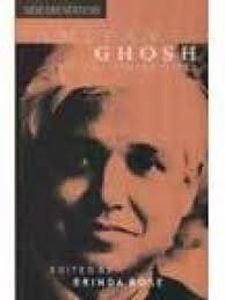
Amitav Ghosh: Critical Perspectives
Contents: Foreword. I. Introduction/Brinda Bose. II. Critical Readings: 1. ‘No Home But in Memory’: migrant bodies and belongings, globalization and nationalism in the circle of reason and the shadow lines/Kavita Daiya. 2. Re-writing the world: the circle of reason as the beginning of the quest/G J V Prasad. 3. Suppressed memory and forgetting: history and nationalism in The Shadow Lines/Vinita Chandra. 4. Fictions of nationhood in Amitav Ghosh's The Shadow Lines/Neelam Srivastava. 5. Between myth and ethnography: an anthropological reading of in an antique land/Roma Chatterji. 6. Texts and worlds in an antique land/Shirley Chew. 7. When Speaking with ghosts : spectral ethics in the Calcutta Chromosom/Bishnupriya Ghosh. 8. "In Time of the Breaking of Nations" : The Glass Palace as Postcolonial Narrative/Rakhee Moral. 9. Mimic missions: coundown as critique of the Nuclear Arms Race in South Asia/Tapan Basu. III. Pedagogy: 10. Gender, nation, history : some observations on teaching The Shadow Lines/Meenakshi Malhotra.11. The problem of chronology and the narrative principle in The Shadow Lines/Mita Bose. 12. A students' colloquium on studying The Shadow Lines/Arunima Paul, Swaati Chattopadhyay, Neha Dixit and Arunima Sengupta.13. Refracted light : teaching in an antique land/Srimati Basu. IV. Interview : 14. An interview with Amitav Ghosh/Neluka Silva and Alex Tickell.
Amitav Ghosh: Critical Perspectives presents wide range of incisive scholarly Criticism on he eminent Indian writer's work to date. With An Introduction that places Amitav Ghosh in the Context of his historical/cultural/social/political times, this Anthology brings together both established and new critics in their perceptive grasp of Ghosh's extraordinary oeuvre of fiction, starting from The Circle of Reason (1986) through The Shadow Lines (1988), In an Antique Land (1992) and The Calcutta Chromosome (1996) to the fairly recent The Glass Palace (2000), along with a reading of Countdown (1999), Ghosh's best-known and most influential piece of Political writing. A greater emphasis is placed on The Shadow Lines and In an Antique Land, which have received the widest critical attention and are, as yet, the Ghosh texts most taught in University courses across the world. An innovative 'pedagogy' section in this collection also explores these texts from both teachers' and students' perspectives, as they Play out in classrooms at locations as far apart as Delhi and the American mid-west. An interview with Amitav Ghosh animates this anthology with an authorial intervention that - perhaps unwittingly - both validates and questions the praxis of literary criticism today in its peculiarly postmodern predicament.
