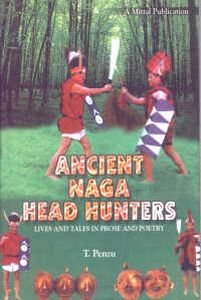
Ancient Naga Head Hunters : Lives and Tales in Prose and Poetry
Contents: Foreword. Preface. Introduction. Presenting folklore tales in poetry. Prologue--this little folklore book. Pronounciation guides of Ao Naga words. Tales: 1. Motives behind head hunting. 2. Two young head hunters. 3. The long haired women. 4. The lone survivor girl. 5. Warrior’s heart with a Red Ant. 6. Revenge for restoration of personal name. 7. The old man and his grandson. 8. Sever my head in a single blow. 9. Rank of a head hunter. 10. Setting fire to enemy village. 11. Messengers of head hunters. 12. Origin of Naga head hunting. 13. Head hunter’s song of challenge. 14. The Swift head hunter. 15. Return of head hunter. 16. Beware of the enemy head hunter. 17. Head hunter’s weapons. 18. Song of head hunter’s child. 19. She offered her head to her lover. 20. Killing of the first Naga Christian. 12. Toshiba in Nokrang village. 22. The two refugee brothers. 23. The tree of skull. 24. A model Naga head hunter. 25. Head hunters’ code of conduct. Epilogue--rescue Mission for the vanishing Naga folklore.
“People around the world know that the forefathers of the present Naga people were head hunters. Head hunting meant that man killed his enemy, cut off his victim’s head, and carried home the head as a victor’s trophy.
Ironically, there were no murders or secret killings. There was no random killing of people just for head counting. There was a set of unwritten laws that guided the head hunters.
It is a unique book in a sense that its author-poet himself is a direct descendant of famous Naga head hunter-warriors. Stories in longer poems are true stories stranger than fiction. (a) Shorter narrative poems give pictures of head hunters’ lives in general. (b) Longer poems narrate real-life stories of head hunters in details.
To avoid any possible injury of hearts in the minds of today’s descendants of earlier head hunters, author have converted all names of locales of the stories, characters or actors and actresses of the tales into fictitious names. Presentation of tales in fiction form also prevent raising again of any dormant ill-feeling down in the human hearts of head hunters’ descendants.
Its author-poet had collected material of this book from the following sources: (i) Tales in shorter narrative poems are from those which he had learnt from old-generation people during his childhood and youth in his village, Merangkong, a hub of Naga folklore and culture. (ii) Details stories narrated in longer poems were collected from tale-bearing old men in different rural Naga villages elsewhere in Nagaland as well as from his birth village.” (jacket)
