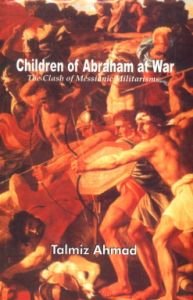
Children of Abraham at War : The Clash of Messianic Militarisms
Contents: Preface. Acknowledgements. Introduction. 1. Messianism in Semitic traditions. 2. Messianism and violence. 3. Jewish Messianism. 4. Messianism and contemporary Israeli politics. 5. Christian Messianism in the USA. 6. The Christian right, the Neocons and US polity in West Asia. 7. Resurgent Islam: the intellectual narrative. 8. Resurgent Islam: the political narrative. 9. Al Qaeda and global Jihad. 10. Contemporary Islamic Messianism. 11. Children of Abraham at war. 12. The theatres of contemporary conflict. 13. The badge of all our tribe. 14. The way forward.
Contemporary terrorism reveals the central role of religion in terms of providing its ideology, organization and motivating impulse. Societies move into crises when existing secular models are seen as having failed to fulfil the developmental, psychological and cultural aspirations of the populace. They then often trace contemporary shortcomings in their lives and the parlous state of their polities to the erosion of religious belief and its diminished influence in contemporary society, and seek solace by harking back to the “fundamentals” of their faith.
However, it is only when fundamentalism is clothed in the garb of Messianism that we obtain the essential precondition for violence against “the Other.” Messianic movements generally emerge in an environment of chaos and anarchy, when the existing political, social and economic order is deeply disturbed, and there is a pervasive sense of social insecurity and unrest. In such situations, believers, seeking comfort, solace and redemption in an ideal, sinless utopia, are convinced that the messianic era is imminent and its advent will be precipitated by their actions. Messianic movements also demonise the enemy, seeing him as Satan or Antichrist. In this conflict with evil, God is an active role-player, providing divine sanction for the perpetration of the most horrendous violence against the “Other”, which is identified as a collective enemy among whom “no-one is innocent.
Messianic belief has been central to the three Semitic religious traditions since their inception and it has remained a vibrant force throughout their history, as the three peoples at different times endured crises and calamities which became tolerable only because of their immutable faith in their messianic destiny.
