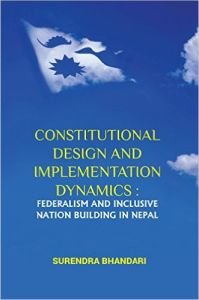
Constitutional Design and Implementation Dynamics: Federalism and Inclusive Nation Building in Nepal
Contents: Preface. 1. The dynamics of designing the constitution of Nepal, 2015. 2. The politics of constitutions making in Nepal. 3. Nation building: challenges and opportunities. 4. Gender and citizenship issues: from the past to the 2015 constitution. 5. Parliamentary oversight and the science of legislation. 6. The model of participatory Democracy and inclusion under the constitution. 7. Federalism the Nepalese modality of power sharing and implementing the 2015 constitution. 8. Landlocked with political traps and blockade: the challenges of nation building. 9. Treaty-making power in the 2015 constitution of Nepal. 10. Concluding remarks: the prospects for the 2015 constitution. Annexures. Bibliography. Subject Index.
The book explicates a liberal democratic constitution as the bedrock for accomplishing the nation building process. In this context, the federal republican design of the 2015 Constitution and its implementation explain the possible paths and leeway of nation building in Nepal. Despite being one of the main driving forces of the 2015 Constitution, from the very beginning of its derivation, federalism is facing arcane challenges. Any delay and intransigence on the part of political actors in establishing the federal institutional structures may turn to be the stumbling blocks in questioning the foundation of the 2015 Constitution.
This book argues that Nepal’s nation building process is likely to be shaped by a number of factors: political stability, successful operationalization of the 2015 Constitution, building a robust market, ensuring universal social protection for social justice, warranting a sense of equal citizens, and realizing good governance, among others. However, these factors seem largely amenable to Nepal’s bilateral relations with its neighbors, especially with India and China. In fact, India and China can be either a trap or a facilitator. Unless India is ready to switch the classical buffer zone policy towards Nepal by standing out for cementing bilateral relations based on international law. Nepal’s nation building process is likely to continue facing a number of painful ebbs and flows.
