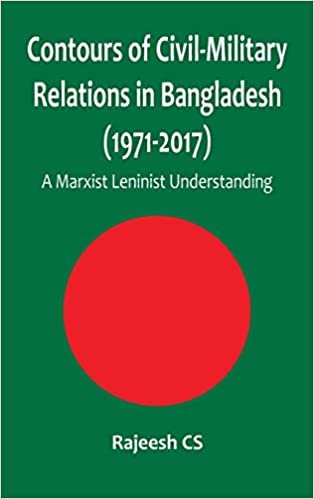
Contours of Civil-Military Relations in Bangladesh (1971-2017): A Marxist Leninist Understanding
Contents: 1. Introduction. 2. Civil-Military Relations: A Theoretical Exploration. 3. The History and Evolution of Civil-Military Relations in Bangladesh. 4. The First Army Intervention: Fall of Mujib. 5. The 1990 Mass Upheaval: The Fall of Ershad A Military Dictator. 6. Political System and Developments in Bangladesh. 7. Ziaur Rahman and Military Autocracy: 1975-1981. 8. Military Backed Interim Government: 2007-2008. 9. Growing Distortions and Politicized Civil-Military Relations in Bangladesh. 10. Civil-Military Relations and Politics of Ziaur Rahman: Authoritarianism and Modernization. 11. Weakened National Assembly (Jatiya Sangsad) and Civil-Military Relations. 12. Changing Contours of Civil-Military Relations in Bangladesh. 13. Assessing Civil-Military Relations through Three Stages: The Case of Bangladesh. 14. Trivial Stages of Civil-Military Relations: 1971-1991. 15. Civil-Military Relations in Bangladesh (2001-2006): The Trivial Stage. 16. Civil-Military Relations (2008-2013): The Balanced Stage. Conclusion. Bibliography. Index.
This book projects up a thematic overview of Bangladesh civil-military relations over more than four decades by emphasizing on Marxist-Leninist lens. The book argues that Bangladesh military has a legacy of coups which began during the Pakistan era. Because of its organisational skill, structure, recruitment, ideology, colonial and the Pakistan legacy, and the fact of its involvement in the liberation war, the army had a stronger position than any other organisation in the state. It tried to elucidate the historical and post-independent nature of civil-military relations by applying Marxist Leninist Analysis of army and civil military relations. At the end, book stresses on the right balance between political leadership and army in working to develop a modernised political and military system without compromising the external and internal security interests of the country.
