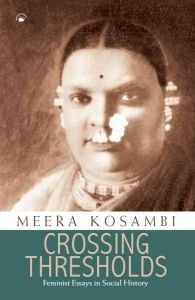
Crossing Thresholds : Feminist Essays in Social History
Contents: Preface and acknowledgements. Part I. Ideological constructions and reconstructions: 1. Introduction: Multiple thresholds. 2. A prismatic presence: Anandibai Joshee through iconized readings. Part II. Home and beyond: 3. Home as universe. 4. Walking on the edge: female body and self. 5. 'A window in the prison house': women's education. 6. Feminist Utopian visions: Kashibai Kanitkar's creative writing. 7. Gender and nationalism. Part III. Wifehood, motherhood, widowhood: 8. Resisting conjugality: Rakhmabai's protest. 9. Child brides and child mothers: the age of Consent Bill (1891) controversy. 10. Motherhood in the east-west encounter: Pandita Ramabai negotiations. 11. Women for all seasons: Anandibai (Baya) Karve and Parvatibai Athavale. Literature cited. Index.
"The notion of the threshold, indicating the restricted periphery of the 'woman's place' in family and society, was firmly embedded in the psyche of nineteenth century women is Western India. Yet some remarkable and articulate women (who are the focus of this book) 'transgressed' patriarchal boundaries--crossing thresholds, literally and metaphorically -- to make their mark in the public sphere. These Indian women created the 'first ripple feminism' of the region.
Nineteenth-century men also inhabit the book social reformers and those who helped these women, as well as conservatives who opposed both the reformers and the progressive women. The central objective of professor Kosambi's book is to interrogate official social history--which posits strong male reformers and passive women's recipients--as well as retrieve and assess women's own pioneering contribution to their proto-feminist efforts.
The introduction presents a conceptual framework of public/private spheres, attempts to retrieve women's subjectivity through their published narratives, and discusses questions of representation and 'voice'.
The ten essays that follow span a variety of topics--the politics of iconizing individual women, women's complex relationships to their homes and their bodies, women's exposure to education and nationalism, the nature of conjugality and 'consent', ideas of motherhood and widowhood.
Uniting all these themes is the effort to amplify women's voices and reconstruct their experiential worlds.
The book straddles the areas gender studies, history and Asian studies while underscoring the resonance of these women's lives with those of other women across South Asia and the West." (jacket)
