Design and Development of a Power Tiller-Operated Vegetable Transplanter
Contents: 1. Introduction. 2 production of plug seedlings for mechanical transplanting. 3 design of a vegetable transplanter. 4 development and methods of performance evaluation. 5 performance evaluation of the vegetable transplanter.
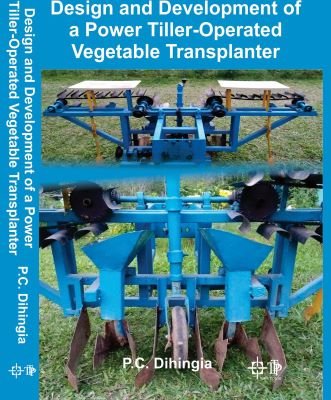
This book highlights the importance of agricultural mechanization in improving productivity, efficiency, and safety in Indian agriculture. It focuses on the design and development of a vegetable transplanter compatible with a power tiller. The book addresses the need for affordable and appropriate machinery to support vegetable cultivation, particularly in regions where power tillers are widely used. It explains the concept of integrating a vegetable transplanter with the rear attachment section of a power tiller. The publication emphasizes the role of mechanized transplanting in reducing manual labour and improving operational efficiency. It explores how suitable farm machinery can help farmers save time, reduce drudgery, and improve working conditions. The book recognizes that agricultural mechanization must be adapted to local soil types, agro-climatic conditions, and farmers’ requirements. It encourages the development of need-based machinery to address the diverse challenges of Indian agriculture. The design provides a useful foundation for further innovation in small-scale vegetable transplanting equipment. The book highlights the importance of engineering design, fabrication skills, and practical experience in agricultural machinery development. It can support students, agricultural engineers, technicians, researchers, and innovators interested in farm mechanization. The publication also emphasizes the potential of appropriate machinery to improve the efficiency and sustainability of vegetable production. The fabrication experience documented in the book demonstrates the value of collaboration between agricultural innovators and local engineering workshops. It encourages further research, design improvements, and field-level evaluation to enhance the performance and usefulness of the transplanter. Overall, this book serves as a practical reference for promoting affordable, farmer-oriented mechanization and advancing agricultural innovation in India.
