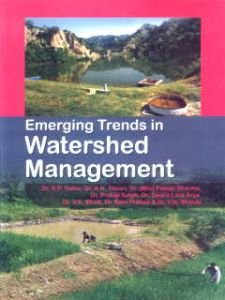
Emerging Trends in Watershed Management
Contents: Foreword. Preface. Acknowledgements. I. Natural resource appraisal: 1. Managing natural resources of Northern India for environmental and livelihood security/V.N. Sharda. 2. India-60: natural resources management and poverty reduction/K.G. Tejwani. 3. General perception of deforestation, soil erosion and Himalayan environmental degradation: a costly mistake/Tej Partap. 4. Remote sensing of land degradation processes with special reference to Northern India/V.K. Dadhwal and S.K. Saha. 5. Land degradation in Northern India: its extent of occurrence, impact on productivity and restorative mechanisms/R.P. Yadav, Swarn Lata Arya and A.K. Nitant. 6. Surface and sub-surface water in Northern states-present water scenario and future strategies/V.K. Bhatt and A.K. Tiwari. 7. Statewise trend analysis of cropping system in Northern region/Pratap Singh. 8. Assessment of erosion hazards for conservation planning in low hill region of Uttarakhand Himalaya/K.S. Dadhwal, S.C. Mohan, S.S. Shrimali, S.K. Dhyani and A. Raizada. 9. Extent of area affected by torrential erosion in Shivalik region of Himalayas/A.K. Tiwari, R.K. Aggarwal and P.K. Sharma. 10. Astro-based indigenous techniques for weather forecast and their verification for Chandigarh/Yogendra Agnihotri. 11. Soil erodibility indices under different land uses in lower Shiwaliks/M.J. Singh and K.L. Khera. II. Rainwater management for sustainable productivity: 12. Current trends in efficient water management and future challenges/K.D. Sharma and R. Jha. 13. Groundwater augmentation for sustainable productivity/M.P. Kaushal. 14. Water conservation and management technologies for attaining higher productivity/R.K. Batta, A. Upadhyaya and A.K. Sikka. 15. Rainwater harvesting for enhancement of socio-economic condition of Kandi area/Nilesh Biwalkar, S.C. Sharma, D.S. Rana and S.S. Bawa. 16. Effect of drip irrigation and polyethylene mulch on water use efficiency, yield and quality of tomato and strawberry/J.N. Raina and I.P. Sharma. 17. Introduction of infiltration galleries as subsurface dams in Shiwalik foothills of Panchkula District in Haryana/J.P. Singh, Dalip Kumar, N.K. Rana and A.K. Tiwari. 18. Laser land leveling - an efficient technology for water saving/Thakar Singh, M.S. Gill, Sukhpreet Singh, A.S. Sidhu and G.S. Brar. 19. Technology for rainwater harvesting and recycling for sustainable development of agricultural watersheds/R.P. Yadav, R.K. Aggarwal, Swarn Lata Arya, A.K. Tiwari, Pratap Singh and Ram Prasad. 20. In-situ moisture conservation practices for higher wheat production in North-west sub-montane region of India/N.K. Sharma. 21. Effect of different irrigation geometry on water and nutrient use efficiency of potato-sunflower sequence/S.S. Thind, A.S. Sidhu, N.K. Sekhon, C.B. Singh, Tarinder Kaur and Amanpreet Kaur. III. Emerging trends in watershed management to meet global challenges: 22. Emerging trends in watershed management to meet global challenges/D.C. Das. 23. Implications of global climatic change on agriculture/P.K. Aggarwal. 24. Organic farming: status and potentials for resource conservation in Northern India/Pawan Sharma. 25. Impact of climate variables on rainfed agriculture and performance of forest trees in mid-hills of Chamba district of Himachal Pradesh/S.K. Bhardwaj, K.S. Verma and M.L. Bhardwaj. 26. Land evaluation and farming system analysis for land use planning in rainfed hill and mountain ecosystem/Ratan Singh, D. Mandal, S.K. Dhyani and B.L. Dhyani. 27. Effect of drip fertigation and soil fertilization on nutrient distribution and yield of apricot cv. New castle/Tarika Sharma and J.N. Raina. 28. Runoff and soil loss as affected by different intercrops with maize in relation to productivity in the Kandi region of Jammu/K.R. Sharma and Sanjay Arora. 29. Effect of anthropogenic activities on some soil attributes from a mixed sub-catchment in submontane Punjab/M.S. Hadda, Dapinder Pal Singh and Monika Vashistha. 30. Soil site suitability for growing different crops in Kiar Nagali micro-watershed in North-west Himalayas of Himachal Pradesh/D. Tripathi, J.R. Verma and I.P. Sharma. 31. Application of sediment delivery ratio with USLE for prediction of soil loss from micro-forest watersheds/V.K. Bhatt, A.K. Tiwari and P. Bhattacharyya. 32. Effect of land development and moisture conservation techniques on crop productivity in watershed area/Pratap Singh, R.P. Yadav, Pawan Sharma, Swarn Lata Arya, V.S. Katiyar, Ram Prasad and R.S. Nain. 33. Amelioration of heat stress in Soybean (Glycine Max. L) by microclimate modification techniques in Punjab/Prabhjyot-Kaur, Harpreet Singh and S.S. Hundal. IV. Land use options and enterprises for environmental and livelihood security: 34. Sustainable development of horticulture in India/H.P. Singh. 35. Land use planning for sustainable crop production and livelihood security in the Himalayan region/Jagmohan Singh. 36. Wasteland development in Shiwaliks through participatory approach - a case study/V.S. Katiyar, Pratap Singh, Swarn Lata Arya, R.K. Aggarawal, Pawan Sharma, R.P. Yadav, Ram Prasad and A.K. Tiwari. 37. Eco-restoration of degraded community land and associated livelihoods in mid-altitudes of Central Himalaya/B.P. Kothyari and S.K. Bhuchar. 38. Watershed development and forest biomass extraction - striking a right balance for the Himalayan region/A. Raizada, Pradeep Dogra and B.L. Dhyani. 39. Scope of geotextiles for rehabilitation of degraded slopes/G.P. Juyal and S.K. Dhyani. 40. Effect of fencing on soil quality in North-eastern tract of Punjab, India/M.S. Hadda, K.B. Thapa and Sanjay Arora. 41. Integration of sericulture for environmental and livelihood security for changing socio-economic scenario of Northern India/G.S. Maurya, Ramakant, A.C. Juyal and M.M. Bhatt. 42. Silvipastoral approach in enhancing natural resources and productivity of native pastures for livestock production in the mid-hills of HP, India/O.P.S. Khola, Bimal Misri, S.K. Sharma, Inder Dev and Sudesh Radotra. 43. Comparative efficiency of vegetative measures in torrent bank stabilization in Shivalik region of lower Himalayas/Pawan Sharma, A.K. Tiwari, Ram Parsad, Swarn Lata Arya and Harish Sharma. 44. Effect of harvest maturity on the storage quality of aonla (Emblica officinalis) cultivars under Shivalik hills/V. Garg, K.S. Thakur and Ram Prasad. 45. Utilization of degraded bouldery riverbed lands through Paulownia based silvipastoral system/Charan Singh. V. Institutional mechanisms and policy issues: 46. Livelihoods security options for small and marginal farmers in the hilly region - land use options for environmental and livelihood security/Jyotsna Sitling. 47. Role of micro credit and financial institutions in agricultural and rural development/Ashok Kumar. 48. Socio-economic status in Northern states/Swarn Lata Arya, R.P. Yadav and R.M. Madhukar. 49. Economic analysis of integrated watershed development project - a case study of NWDPRA watershed in Uttarakhand/B.L. Dhyani, G.P. Juyal, A. Raizada and B.N. Ghosh. 50. Controversies emerging from new generation of decentralized watershed development projects/S.S. Grewal. 51. Drinking water crisis in India: some gender concerns/Ravinder Kaur. 52. Impact analysis of joint forest management policy on sharing and management of common property resources in Shivalik foothill villages in Haryana, India/Sarn Lata Arya and V.N. Sharda. 53. Empowerment of rural girls through intervention/Anju Manocha, Santosh Sangwan and Anju Aneja. 54. Economic feasibility of renovating water harvesting structure with package and practices of cultivation in Shivaliks - A case study of Himachal Pradesh/Surinder Singh, A.K. Tiwari, P. Bhattacharyya and Pratap Singh. VI. State's experiences and future thrust: 55. Potential and constraints of the watershed programme/S.S. Saini. 56. Dynamics of fruit crops over time with area under coverage, productivity and soil conservation value in Northern states/Ram Prasad and S.K. Yadav. 57. Status of horticulture in Himachal Pradesh/Gurdev Singh. 58. Status of horticulture development in Haryana - potential and constraints/Satyavir Singh. 59. Financial analysis of poplar based agroforestry system - a case study/D.P.S. Nandal, B.S. Mandal, J.C. Kaushik and R.S. Chauhan. Author index.
"Over exploitation of natural resources resulting in their severe degradation, diminishing water resources, declining forest cover, depleting energy sources, loss of biodiversity and about 45% of total geographical area of the country is degraded due to various processes of land degradation with water erosion affecting maximum area of 93.7 m ha. Land degradation causes 5% to more than 50% decline in total agricultural output every year and a loss of around 8 m tonnes of plant nutrients occurs due to water erosion annually. Intensification of agriculture in irrigated regions has also resulted in many second generation problems viz; water logging and salinization, soil sickness, nutrient imbalances etc. Hence, efficient management and utilization of land, water and vegetation resources to meet the growing basic human and animal needs in terms of food, fibre, fodder, timber and fuel continues to be an issue of utmost concern for policy makers, planners, conservationists and environmentalists.
This book has 59 chapters under six broad themes. Under natural resource appraisal theme status of soil erosion, land degradation, surface and ground water availability and quality, impact of human and livestock on biodiversity and land quality were discussed. Efficient techniques of water harvesting systems. ground water utilization and multiple uses for sustaining productivity were discussed under rainwater management for sustainable productivity. Alternative land use systems for improving land degradation and enhancing economic returns were discussed at great length in section 4. The topic under institutional mechanisms and policy issues were benefit sharing mechanism among stakeholders, capacity building and community empowerment, impacts and implications of watershed guidelines and gender and equity issues. State's experiences on these burning issues were shared by state department heads and eminent scholars and future thrust were highlighted. It is hoped at the book will prove very useful to scholars, managers, policy makers and society at large in achieving environmental and livelihood security for the people of the country."
