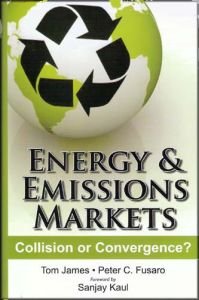
Energy and Emissions Markets: Collision or Convergence
Contents: Foreword. Glossary. 1. Setting the Stage for Collision or Convergence. 2. The Birth of the Global Emissions Markets. 3. Green Trading Schemes. 4. Global Trading Schemes. 5. Market Mechanisms for Reducing Emissions. 6. Overview of the Carbon Exchanges. 7. Carbon Collides with Power The European Experience. 8. Legal Agreetments for Emmissions Trading. 9. Green Power Trading: Developments and Opportunities. 10. What Risk? An Introduction to Managing Risk. 11. Risk-Policy Guidelines. 12. Managing Financial Risk for the Environment. 13. Investment Opportunities in Emissions. 14. Broader Issues for Business Global Emissions Markets. 15. What the Future Holds: Opportunities for Global Market Convergence. Appendices. Index.
As the worlds energy markets continue to expand in the light of rising global demand, environmental standards such as the Kyoto Accord are creating uncertainty and greater price volatility in energy markets. This comprehensive book discusses traditional energy trading markets, the impact of emissions trading schemes and the advent of renewable energy trading.
Written by renowned energy market expert and commentator, Professor Tom James and best-selling author Peter C. Fusaro, this book demonstrates that the forces of energy and environmental issues are linked more than ever before. The beginning of European emissions trading in 2005 and the implementation of the Kyoto Protocol have accelerated efforts already underway in the U.S. and elsewhere to use market forces to remediate environmental issues.
In response to its Kyoto obligations, Europe decided on a trade and cap emissions-trading scheme. This allows governments to regulate the aggregate amount of emissions produced by setting an overall cap but gives companies the flexibility to determine how and where the reductions are achieved.
On 1 January 2005, the European Union Emissions Trading Scheme (EU ETS) came into force and introduced a new dimension to energy trading. From now on, the cost of emissions from the use of a fuel would have to be taken into account as part of the whole net cost calculation.
This new dynamic in energy pricing converged and in some cases collided with energy markets. Drawing extensively on the first year of the EU ETS, this book, Energy and Emissions : Collision or Convergence? explores the developments of emissions regulation, emissions-trading schemes, and how they are interacting with energy markets across the globe.
