Exclusion and Discrimination : Concepts, Perspectives and Challenges
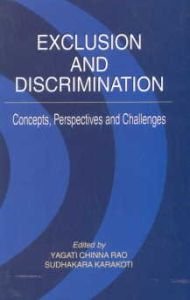
Contents: Foreword. Preface. Introduction. I. Concepts and theories: 1. Social exclusion in India: concepts and context/Y. Chinna Rao. 2. Exclusion and exploitation: a conceptual understanding/V. Ravindra Sastry and G. Ram Reddy. 3. Social inclusion and social justice: a historical perspective/Shura Darapuri. 4. The constitution of India: an antidote tot he Manusmriti-remedies to caste and poverty/Netrapal Singh. II. Perspectives on exclusion and discrimination: 5. Caste oppression, economic discrimination and poverty among Scheduled Castes in India/Sudhakara Karakoti and Raghunath Prasad Saket. 6. Discrimination and humiliation: the Uttar Pradesh experience/Pragati Burman and Sudhakara Karakoti. 7. Democracy, Dalits and exclusive policies: a case of Scheduled Castes in Arunachal Pradesh/Chunnu Prasad. 8. Chinki: Is it a racial category or a vilification tag?/N. William Singh. 9. From untouchables to Dalit Christians: conversion and social exclusion/L. David Lal. 10. Systematic exclusion of Dalits in Indian society/Rabindra Kumar. III. Exclusion and discrimination in education: 11. Emerging challenges of equality: private educational sector in Kerala/G.S. Suresh Babu. 12. The politics of tribal education and governance: the Orissa experience/Pankaj Deep. 13. Social exclusion and elementary education: a case study of STs in India/Sujit Kumar Choudhary. 14. Combating social exclusion in education: Re-examining the inclusive framework/Jagannath Ambagudia. 15. Poverty, social exclusion and basic education: the Tamil Nadu experience/Poornima M. IV. Facing the challenges: 16. Indian judiciary and problems of the poor: where do the marginalized find place?/Pallavi Bahar. 17. Disability, inclusiveness and PRIs in India/Vikash Kumar. 18. The rhetoric of exclusive development/Shailaja Menon. 19. Agenda against social exclusion: democracy, development and citizenship/Avinash Kumar. Index.
"In social sciences literature, there is a general agreement on the core features of social exclusion, its principal indicators, and the way it relates to inequality. Social exclusion is the denial of equal opportunities to some groups in a society by some dominant groups, which leads to the inability of the affected/excluded individual to participate in the basic political, economic and social functions within the society. Recent developments in social science disciplines enable us to better comprehend the meanings and manifestations of the concept of social exclusion, and its applicability to caste and ethnicity-based exclusion in our country. Accordingly, in social sciences literature, the concept of social exclusion - essentially refers to the processes through which groups are wholly or partially excluded from full participation in the society in which they live. It emphasises two crucial dimensions involving the notion of exclusion, namely the "societal institutions" (of exclusion), and their "outcomes" (in terms of deprivation). Many works on this subject are either by economists and specialists on health related aspects or they are on international perspectives. Generally studies on \'Exclusion and Discrimination\' are relatively new to India."
