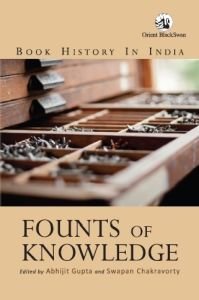
Founts of Knowledge
Contents: Introduction. 1. Benares beginnings: print modernity, book entrepreneurs, and cross-cultural ventures in a colonial metropolis/Ulrike Stark. 2. At home in Bombay: housing Konkani print/Rochelle Pinto. 3. Six blind men and the elephant: Bhagavata Purana in colonial Bengal/Varuni Bhatia. 4. Childspeak: Children’s periodicals in Hindi in colonial north India (1920–50)/Nandini Chandra. 5. Bangla literary journalism at nationalism’s ‘moment of departure’: the intervention of Bangadarsan/Samarpita Mitra. 6. On the wrong end of the Raj: some aspects of censorship in British India and its circumvention during the 1920s-1940s-Part 2/Graham Shaw. 7. Educational texts in Bengal, 1830–1900: some problems relating to British imports/Swapan Chakravorty. 8. What really happened under a tree outside Delhi, May 1817/Abhijit Gupta. Index.
Founts of Knowledge is the third in a series titled ‘Book History in India’, which was started in 2004 to showcase the latest research in what was then a nascent field in India-the history of the book. It continues the trajectory of the first two volumes (published by Permanent Black) in establishing book history as a major tool of enquiry in the Indian academy, and brings together the finest scholars and the most recent research in the area.
This volume carries the second instalment of the four-part study of censorship of print during the Raj. It also examines print modernity and book entrepreneurs in colonial Benares; the complex history of Konkani print culture; the re-configuration of the community and building of a reading public by the coming of print in undivided Bengal through studies of the Bhagavata Purana and the literary journal Bangadarsan; the construction of childhood through Hindi children’s periodicals in north India in the early twentieth century; early travels of the Bible in the Gangetic plain; and problems relating to the import of British educational texts in colonial India, especially Bengal.
This collection will be an invaluable resource for book historians, literary and textual scholars, historians of colonial India, historians of trade, social scientists, and researchers in media theory. It will also be of great interest to students and scholars of history, literature, publishing studies, print culture and cultural studies.
