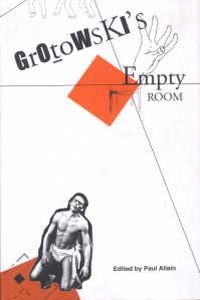
Grotowski\'s Empty Room
Contents: Acknowledgements. Editorial preface. I. 1. Letter to Jerzy Grotowski/Eugenio Barba. ii. The man in her dream/Marianne Ahrne. II. 3. Grotowski and the Reduta tradition/Zbigniew Osinski. 3. Grotowski and Flaszen: why a theatre laboratory?/Leszek Kolankiewicz. 4. My second meeting with Grotowski/Zdenek Horinek. III. 5. The empty room: studying Jerzy Grotowski\'s Towards a poor Theatre/Franco Ruffini. 6. Grotowski\'s double vision/Ferdinando Taviani. 7. Grotowski and the twentieth-century theatre\'s secret/Marco De Marinis. 8. The theatrologist, the spectator and the \'performing arts\': Grotowski\'s and the workcenter\'s challenge/Marco De Marinis. 9. Grotowski, or the Border Ferryman/Marc Fumaroli. Appendix: From the film Il Teatr Laboratorium di Jerzy Grotowski: Jerzy Grotowski interviewed by Marianne Ahrne. Notes on contributors.
"Most of Grotowski\'s Theatre-making took place in small theatre and studio spaces, from the tiny theatre of the 13 rows in Opole, through Wroclaw\'s bare Apocalypsis room, to the wine store in Pontedera. At the heart of his long term research was the actor\'s work on him/herself in an empty room. In this book, that empty room is both actual and metaphorical: the workplace; Grotowski\'s Spartan home; a notion for analyzing Grotowski\'s seminal Towards a Poor Theatre; and the paradoxically full vacuum Grotowski\'s death has left for us.
This collection considers how Grotowski\'s explorations in the theatre continue to challenge us, from his research based investigations in his Laboratory days through to the Workcenter of Jerzy Grotowski and Thomas Richards\' ongoing activities. The contributors all knew their Grotowski, and reflect with special insight on how theatre scholars and practitioners can begin to work on and with Grotowski today.
Most of the texts were written after Grotowski\'s death in 1999 and are translated into English here for the first time. Together, they reflect on the various stages of Grotowski\'s work, from the Reduta onwards, offering fresh perspectives on his achievements and endeavours, and prompt us towards asking some important questions--what does Grotowski\'s oeuvre mean for the theater and theatre studies today? What challenge does he still offer us now, 10 years after he left the world \'stage\', and decades after he left theatre-making behind?
