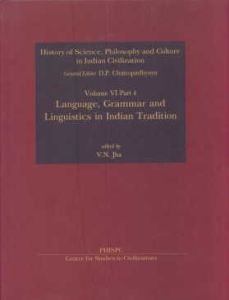
History of Science, Philosophy and Culture in Indian Civilization, Vol. VI. Culture, Language, Literature and Arts, Part IV. Language, Grammar and Linguistics in Indian Tradition
Contents: Diacritics for transliteration. International Phonetic Alphabet (IPA). Preface/V.N. Jha. Editors. Contributors. General introduction/D.P. Chatopadhyaya. 1. Introduction/V.N. Jha. 2. Concept of language in Sanskrit tradition/ V.N. Jha. 3. Philosophy of language/V.N. Jha. 4. Bhartrhari’s philosophy of language/Mithilesh Chaturvedi. 5. Study of language/ V.N. Jha. 6. From speaker’s point of view: how does one speak?/V.N. Jha. 7. From listener’s point of view: how does one understand a sentence?/V.N. Jha. 8. Two aspects of language: form and content/V.N. Jha. 9. Preservation of form: Vedic texts/V.N. Jha. 10. Techniques of preservation (modes of recitation)/V.N. Jha. 11. Sakalya: the Padakara of the Rgveda/V.N. Jha. 12. Sakalya and Panini/V.N. Jha. 13. Emergence of Sanskrit linguistics/V.N. Jha. 14. Juncture-feature as shown by Sakalya/V.N. Jha. 15. Grammatical significance of the symbols ‘S’ (Avagraha) ‘I’ (Danda) in the Padapatha/V.N. Jha. 16. Significance of the term Pada in he Padapath/V.N. Jha. 17. The principles of immediate constituent analysis and isolation of items in the complex forms/V.N. Jha. 18. Sakalya’s theory of Avasana-Sandhi/V.N. Jha. 19. Cast-terminations and their treatment/V.N. Jha. 20. Perfect participate suffix: Vams and its treatment in the Rgveda Padapatha/V.N. Jha. 21. The treatment of iva-compounds in the Rgveda Padapatha/V.N. Jha. 22. Iti-Karana device in Rgved Padapath/V.N. Jha. 23. Pre-Paninian Tradition of grammar and linguistics/Hukam Chand Patyal. 24. Paninian tradition of grammar and linguistics/Rama Nath Sharma. 25. Language description in Panini/Avanindra Kumar. 26. Post-Paninian traditions of grammar and linguistics/Karuna Sindhu Das. 27. Preservation of content/V.N. Jha. 28. Science of etymology/Hukum Chand Patyal. 29. Science of lexicography/Hukum Chand Patyal. 30. Science of sentence interpretation/Ujjwala Jha. 31. Types of language/V.N. Jha. 32. Ordinary language/V.N. Jha. 33. Scientific language/V.N. Jha. 34. Language of art/V.N. Jha. 35. Meta-language/V.N. Jha. 36. Linguistic communication models/V.N. Jha. 37. Communication through ordinary language/V.N. Jha. 38. Communication through language of art/V.N. Jha. 39. Development of artificial language (Navya Nyaya Language)/V.N. Jha. 40. Resume/V.N. Jha. Select bibliography. Index of Sanskrit terms.
"The volumes of the Project on the History of Science, Philosophy and Culture in Indian Civilization aim at discovering the main aspects of India’s heritage and present them in an interrelated way. These volumes, in spite of their unitary look, recognise the difference between the areas of material civilization and those of ideational culture. The Project is not being executed by a single group of thinkers and writers who are methodologically uniform or ideologically identical in their commitments. In fact contributions are made by different scholars with different ideological persuasions and methodological approaches. The Project is marked by what may be called ‘methodological pluralism’. In spite of its primary historical character, this Project, both in its conceptualization and execution, has been shaped by many scholars drawn from different disciplines. It is for the first time that an endeavour of such a unique and comprehensive character has been undertaken to study critically a major world civilization.
This volume contains thoughts about language, Grammar and Linguistics in Indian Tradition. It is the product of research work conducted on a variety of aspects on language right from the Vedic era up to medieval period. Eminent scholars have contributed to the volume on a variety of themes such as concepts of language, philosophy of language, formal aspect of language, phonetics and phonology, semantic aspect of language, lexicography, science of grammar, science of sentence-interpretation, theory of communication through the natural language and through the language of art and artificial language for precise communication. These themes are presented in a structured form, keeping Panini, the fifth Century Sanskrit Grammarian and the first descriptive linguist know to the world, at the centre. One will find a broad picture of concept of language, grammar and linguistics before Panini, in Panini and after Panini in this volume.
For the first time, one will find in this volume, a detailed account of contributions of non-Paninian Sanskrit Grammarians. One will also find ancient Indian philosophers, particularly, of Bhartrhari and Indian Logicians’ views on language. The contributions of the Purvamimamsa philosophy to the idea of discourse analysis and Indian Hermeneutics have also been highlighted. A chapter on artificial language developed by neo-logicians has also been added for the first time in this volume.
The volume aims at developing perspectives for studying ancient Indian linguistic data from various angles in contemporary grammatical, linguistic and philosophical idiom in order to encourage future researching these areas. The book is addressed to the educated laity and not just to students or specialists on the subject.” (jacket)
