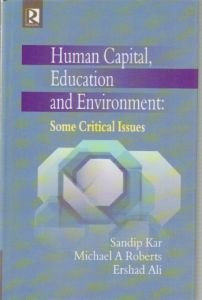
Human Capital Education and Environment : Some Critical Issues
Contents: Preface. 1. Human capital education and environment: an overview/Sandip Kar, Michael A. Roberts and Ershad Ali. 2. Role of HR practices in small construction projects with special reference to India/Sandip Kar. 3. Is development under free market economy sustainable?/Ratan Lal Basu. 4. Role of education and skill in the process of human resource development towards growth and development of national economy/Debdas Ganguly. 5. Internationalization of educational environment: impacts on perceived quality/Mike A. Roberts. 6. Human capital and learning strategies: some relations/Angela Carvalho and Rosa Bizarro. 7. Women participation in the development process of Malaysia/Geetha Subramaniam and Ershad Ali. 8. Education and human health: the two basic human capitals for the economic development of India/Dhirendra Nath Konar. 9. Role of human capital in service sector quality management: a study on drinking water supply system in a major city of Orissa State in India/R.N. Muni and P.K. Padhy. 10. Human value in transportation management of Indian railways/K.C. Gonda and A.K. Panda. 11. A meta regression analysis of the impact of climate change on agriculture/Gargi Basu. 12. The intercultural stance at a distance: creating real proximity through the virtual world/Ana Paula Teixeira and Rosa Bizarro. 13. Eco Tourism and its impact on carrying capacity at Kodaikanal: hilly tourist resort of South India/V. Dhulasi Birundha. 14. Human capital formation is a precondition for sustainable environment of a nation: lesson learnt/S. Kar, M. Roberts and E. Ali. Index.
Sustainable environment and efficient human capital, among others, are important factors for achieving desired developmental aspiration of every nation. Knowledgeable and skilled human capital can produce goods and services in more efficient way which ultimately saves environmental degradation wisely.
Investment in education does not only contribute in building human capital and environmental sustainability by using resources efficiently, but also contributes positively to other socio-economic factors of the society. Some of these factors are such as the investment in education contributes to eradicate poverty, reduce gap of inequality, improves health and nutrition awareness of the family, and so on. In fact, development is the indirect output of overall initiatives taken by a country where investment in education for human capital formation can play a vital role.
In this book is presented discussions on the relationship of sustainable environment, human capital, education, poverty, and human health as well as discussions on different theories and case studies. Based on analysis, we have developed a model explaining the major influencing factors on environment.
