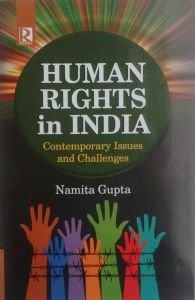
Human Rights in India: Contemporary Issues and Challenges
Contents: Preface. 1. Unsustainable development/Namita Gupta. 2. Violence against women in India/Anupam Bahri. 3. Terrorism in India: a threat to pluralist and democratic values/Supinder Kaur. 4. Child labour in India: laws and application/Sarita Paul. 5. Terrorism: global and Indian scenario/Kanika Sharma. 6. Psychological problems among learning disabled children/Supreet Kaur and Meenu. 7. Dalits and human rights/Sucheta Singh. 8. Problems of the aged in Indian society/Kuljeet Kaur Brar. 9. Differently abled in India: meaning causes and concerns/Pardeep Kumari. 10. Corruption, good governance and moral values/Kamla. 11. Democracy in India: a myth or reality/Shaveta Begra and Kuldeep Singh. 12. Bonded labour/Isha Jain. 13. Sexual and reproductive health and rights in India/Gaurav Gaur. 14. Globalization with a human face: an impact of the new economic policy (1991) on human rights/Jyoti Marwah. 15. Barriers of differently-abled in social, psychological and economical domain/Kuljeet Kaur Brar and Tanu Sharma. 16. Slums as manifestation of urban poverty, social inequality and denial of human rights: some emerging questions in the context of growth of slums in North-Western India/Manoj Kumar Teotia. 17. Domestic violence in India: causes, consequences and remedies/Rajiv Gupta and Namita Gupta. Index.
Human rights are almost a form of religion in today’s world. They are the great ethical yardstick that is used to measure a government’s treatment to its people. A broad consensus has emerged in the twentieth century on rhetoric that frames judgment of nations against an international moral code prescribing certain benefits and treatment for all humans simply because they are human. Human rights are as old as human civilization, but their use and relevance have been well defined during the recent years. It has gathered more importance in the post-second-world war period, particularly after the Untied Nation’s declaration of Human Rights (UNDHR) in 1948. Human Rights stand for dignified existence of human beings.
This book is multidimensional in character with a focus on recurring human rights issues in contemporary India. The book aims at identifying a number of specific human rights issues in India which requires immediate intervention of both state and non-state actors. It also aims to be a reference book for the under-graduate and post-graduate students who want to have an in-depth understating of the contemporary human rights issues in Indian society. (jacket)
