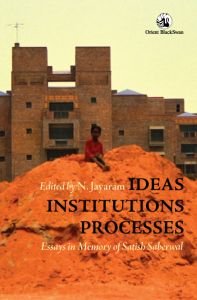
Ideas, Institutions, Processes: Essays in Memory of Satish Saberwal
Contents: Preface. I. Introduction: The Scholar and His Work. 1. A gentleman among scholars; A scholar among gentlemen/N. Jayaram. 2. Satish Saberwal: A memoir/T. N. Madan. 3. For a sociology of India: Satish Saberwal in conversation with Nandini Sundar and Amita Baviskar/Nandini Sundar and Amita Baviskar. II. Disciplinary Ruminations. 4. The challenge of global modernity for sociology in India/Sujata Patel. 5. Overcoming relativism: The question of the appraisal of traditions revisited/Sasheej Hegde. 6. Dalit movement in mainstream sociology/Gopal Guru. III. Studies in History. 7. Chiefdoms and early kingdoms in the Mahabharata/Romila Thapar. 8. Consultation for a code: Nineteenth-century consultation on the proposed commercial laws/Gail Pearson. 9. Reading, writing, region: The early Malayalam novel and the problem of identity/G. Arunima. 10. Towards an environmental history of the Indus water treaty/Rohan D’Souza. IV. Institutions and Processes. 11. Alternative school education and the standardisation of right to education debate/Susan Visvanathan. 12. Post Festum: The bifurcation of the Karnataka State Farmers’ Association in the wake of the inter-continental caravan/Stig Toft Madsen. 13. Primitive rebels? deprivation, caste inequality and the maoist conflict in India/ Ashwini Deshpande. 14. ‘Paying back to society’: The Bamcef-an idea and its network/ M. Rajivlochan. 15. The anthropocene and the conundrums of environmentalism/M. N. Panini. Satish Saberwal: A Bibliography/Compiled by N. Jayaram. Index.
This book commemmorates eminent sociologist Satish Saberwal who pioneered interdisciplinarity in the social sciences in India through a series of 15 collected essays in four different parts.
The first part takes a biographical approach to Saberwal and includes both reminiscences by his peers as well as an extensive interview with Saberwal. The second part is devoted to the methodology of studying sociology in India. The third part is dedicated to historical perspectives, as Saberwal was interested in combining historical and sociological approaches and considers both ancient and modern Indian history. The fourth part focuses on different institutions and processes in contemporary India, and discusses issues like education, caste, violence and environmentalism.
The different essays in the volume draw from Saberwal’s important work on crisis, conflict, social mobility and institutional rules and norms and generate new perspectives on a wide variety of issues.
