Indian Secularism : A Social and Intellectual History 1890-1950
Contents: Acknowledgements. Glossary. Abbreviations. Introduction. I. Nationalism: 1. A Hindu community in Maharashtra? Cow protection, Ganpati festivals and music before mosques 1893-1894. 2. Regionalism to nationalism: Swadeshi and the new patriotism in Maharashtra 1905-1910. II. Communalism: 3. From 'Religious community' to 'communal minority' : Muslim and the debates around constitutional reform 1906-1909. 4. The question of Muslim autonomy: the Khilafat movement and the separation of Sind 1919-1932. 5. III. Secularism: 5. From untouchable to Hindu: Gandhi, Ambedkar, and the depressed classes question 1932. 6. From nationalism to secularism: defining the secular citizen 1946-1950. Bibliography. Index.
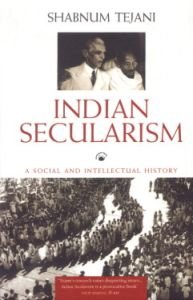
The book examines how secularism came to be bound up with what it meant to legitimately call oneself ‘Indian’ and shows why this concept’s genealogy is so imbued with the language of religion. It argues that the emergence of the category of secularism in India had less to do with creating an ethics of tolerance than with a formulation of nationalism that provided a counterpoint to challenges posed by Muslim and Untouchable communities.
Through a detailed reconstruction of six historical moments, which include the emergence of religious movements and key constitutional debates, Tejani shows that the ideology of secularism that emerged in 1950 had its conceptual preconditions in histories of nationalism, communalism, and British colonial discourses. She also argues that the distinction between religion and caste that has characterized debates on Indian secularism is false. Rather than being distinct from community and caste, nationalism and communalism, liberalism and democracy, Indian secularism was a relational category that emerged at the nexus of all these.
This book will interest students of Indian democracy, politics, and history, as well as of political philosophy and the sociology of caste.
