Man-Eaters and Farmland Killers: Conserving Predators in an Edenic Paradise
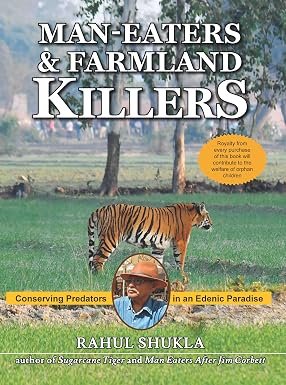
In the Terai, where forests merge with fields of sugarcane, the presence of a tiger can transform everyday life into a state of constant vigilance. For generations, people living alongside these great predators have experienced a mixture of fear, awe and fascination, especially when a tiger crosses the invisible boundary between wild prey and human life. Yet this landscape is also an extraordinary habitat where predators continue to survive and adapt in close proximity to people. Years of close encounters with these tigers gradually changed the way I perceived them. I was no longer merely observing their actions and movements from the outside. I began to look beyond what was immediately visible, trying to understand what lay within the mind of the tiger and what drove its behaviour and its adaptation to farmland. This gave me what I came to regard as a “double vision”, through which I could observe both the external world of the predator and, as far as possible, seek to understand its internal world, its instincts, motivations and the ecological forces shaping its adaptation to human landscapes. I have spent years returning to the Terai to study tigers that have adapted to farmland, particularly what I describe as the “Sugarcane Tiger” phenomenon. I have worked with vulnerable communities to help them understand how to deal with these powerful predators, and have assisted forest personnel in preparing for the capture of tigers that have become a threat to human life. But behind every man eating tiger lies a more complex story. What causes a tiger to enter farmland? Why do some tigers adapt successfully to human dominated landscapes while others become killers? What ecological and behavioural changes enable a large predator to survive in an increasingly human dominated environment? And how can such predators be conserved while also protecting the people who share their habitat? Through years of field observations, encounters and research, I have tried to understand the ecological, behavioural and environmental complexities underlying man eating and farmland adaptation. What I saw with my own eyes, what I heard with my own ears and what I experienced at close quarters gradually revealed a world in which the boundaries between forest and farmland, predator and prey, fear and fascination are constantly shifting. I continued to relish the pursuit of farmland tigers, even those that had been marked or vilified because of occasional man eating. Following them and documenting their ways of surviving in human landscapes became an important part of my work. Each encounter and every field investigation brought new insights, while opening up an almost limitless scope for further discovery. The work was filled with drama, action and considerable danger. Confronting some of the most vicious tigers of the Terai could be intensely thrilling, recalling in its own way the spine chilling adventures once associated with the pursuit of big game. Part natural history, part field account and part exploration of predator and human conflict, Man Eaters & Farmland Killers: Conserving Predators in an Edenic Paradise takes the reader into one of the most challenging and little understood encounters between wildlife and human society. At its heart is a larger question: how can we conserve magnificent predators while enabling people and wildlife to share the same landscape? The book offers an intimate account of tigers living beyond the conventional boundaries of protected forests, their remarkable ability to adapt to agricultural landscapes, the dangers they sometimes pose and the challenges involved in conserving them. It is a story of tigers, people, survival, conflict, conservation and the continuing struggle to understand one of nature’s most formidable predators.
