Modernity and Its Agencies : Young Movements in the History of the South
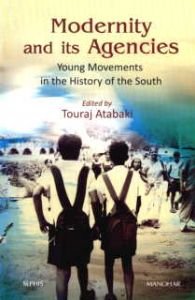
Contents: Acknowledgements. 1. Introduction: the enduring endeavour of the \'young\': some comparative remarks/Touraj Atabaki. 2. The origin, genesis and regional chain reaction of \'young\' movement/Mansura Haidar. 3. Jadid movement in Volga-Ural region/Nadir Devlet. 4. Central Asian Jadidism and the Egyptian Islamic reformism: some comparative remarks/Dilorom Agzamovna Alimova. 5. \'Young India: a Bengal eclogue\': or meat-eating race and reform in a colonial poem/Rosinka Chaudhuri. 6. \'Young Turk\' and the Kemalist reforms: continuities or ruptures?/Samim Akgonul. 7. The young Iranian society/Kaveh Bayat. 8. Ganj Azer against the Soviet rule in Azerbaijan/Solmaz Rustamova-Tohidi. 9. The \'Young modernists\' vs. the \'old Turbans\': reform and resistance in pre-colonial morocco/Fatima Harrak. Index.
"In the past two hundred years, for many enlightened individuals, from South Asia to North Africa, from Persian Gulf to the Adriatic Sea, the main intellectual and political enquiry was to find a path negotiating the rapidly changing world. The world, as they saw, was coming out of \'ignorance\' and heading towards \'science\' and \'progress\'. Labelling the past with obscurity and calling its guardians old and reactionary, the enlightened young became the self-assigned beacons of light leading the masses to a \'time of progress\'.
The word \'young\' in both the south and the north soon evolved into the classical epithet of emerging intelligentsias in their struggle against the despotic rule of the ancient regimes and its supporters, often the clerical establishment. Furthermore, with the practice of colonialism and imperial expansionism, the Asian, African or even some European \'young\' often crafted their identity by rejecting and defying the other, i.e. the colonial power.
In world history one finds very few movements which had such widespread social and political repercussions, simultaneously engulfing at least half of the globe and in the process becoming famously known as the Young Movement.
This volume is the first attempt to study the Young Movement beyond national frontiers. The contributors to this volume not only shed light on the history of the young movement in a number of countries and regions, but also compare and contrast the development of this movement in different parts of Asia and Africa: from Calcutta to Rabat, from Isfahan to Bukhara and from Istanbul to Kazan." (jacket)
