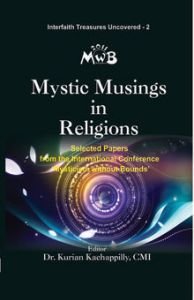
Mystic Musings in Religions: Selected Papers from the International Conference Mysticism without Bounds
Contents: 1. A Note from the Editor.2. Mystics are beyond Religions. 3. Dukkha-Passio: Buddhist and Christian Meanings of Suffering in the Context of Mystical Experience. 4. The Abiding Density of Light: Light and Sound Carved and Chiseled Across the Luminous Black Light of the Islamic and Sufi Void. 5. Sufi Inspired Devotional Islam in Egypt. 6. The Place of the Word of God in Mystical Experience. 7. Buddhist Epistemology of Vipassana and its Meaning. 8. Mysticism without Bounds: Islamic Perspective. 9. Mysticism and Sociability in Daoism from a Christian Point of View. 10. In Quest for the Unbound: Sufi Ritual as Sacred and Secular. 11. Significance of "You Have No Part with Me" in John 13:8: A Potential Mystical Interpretation. 12. Dialogue along Mystics' Spirituality: Models of Effective Interreligious Dialogue in Religious Pluralistic Societies. Contributors. Index.
'Mysticism' is "the pursuit of communion with, identity with, or conscious awareness of an ultimate reality, divinity, spiritual truth, or God, through direct experience, intuition or insight." The International Conference "Mysticism without Bounds" makes an attempt to explore the "mystical consciousness" from different disciplines,like religions (Hinduism, Judaism, Christianity, Islam, Buddhism, Sufism, Taoism, etc), sciences (biology, new physics, neuroscience, and logic), humanities (philosophy, theology, spirituality, psychology, etc.), and art forms (poetry, music, dance, visual arts and rituals). Researches reveal that certain common grounds do exist among the various forms of consciousness, scattered among the world's religions, theologies, sciences, philosophies and art forms. The discovery of such points of convergence holds out the possibility of creating a 'new worldview', and this new world view can create an awareness of the essential 'unity' of humanity. Let these scholarly and challenging papers from different religious experiences create an awareness among the inquisitive readers of the need of overcoming the ‘bounds’ of individuation and discovering the ‘unity’ of self.
