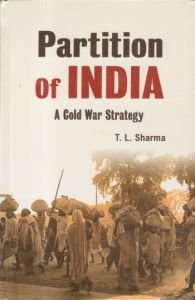
Partition of India: A Cold War Strategy
Contents: Preface. 1. Introduction. 2. The Western strategy. 3. Junagadh. 5. Jammu and Kashmir. 5. Hyderabad. 6. Communalism in free India. 7. Implementation of pre-fabricated plan. Appendix. Bibliography.
Contrary to the general perception that the independence of India and the creation of Pakistan were to meet the long-standing demand of the Congress and the Muslim League, the actual reason that lay behind these two historic developments was the emergence of the Cold War that engulfed the entire Europe soon after the World War II. The lurking fear that India might go the communist way, not only forced Great Britain (a prominent member of the Western Block) to grant independence to India but also to partition the country, so as to keep a foot-hold on the sub-continent, for the protection of her own Indian-ocean interests. To prevent any contiguity of India with the USSR through Kashmir, the Western Block wanted the state of Kashmir to accede to Pakistan. Having failed to get this done, through the efforts of Lord Mountbatten they persuaded Pt. Nehru, of course through Mountbatten, to refer the Kashmir issue to the UNO, when the Indian forces were about to push the Pakistani forces out of the state completely. Consequently, the part of Kashmir contiguous with the U.S.S.R remained with Pakistan. With the aim of keeping India a weak and troubled state, in the case of Hyderabad too the efforts of the Western Block were (of course, through Lord Mountbatten) to keep an independent sovereign Muslim state, friendly to Pakistan, in the heart of India.
