Photographing Civil Disobedience: Bombay 1930–1931
Contents: Preface/Rahaab Allana. 1. Introduction: Words of Light in Disobedient Bombay/Avrati Bhatnagar and Sumathi Ramaswamy. 2. The Stages of a Disobedient Bombay/Preeti Chopra. 3. Visualizing the Urban Crowd: Political Spectatorship in the Age of Cinema/Debashree Mukherjee. 4. From Profits and Patriotism to Gandhian Austerity: Transformations in Bombay’s Swadeshi Landscape/Dinyar Patel. 5. Salt of the City/Sumathi Ramaswamy. 6. The Suburban Congresswoman/Murali Ranganathan. 7. Boycotting Women: The Street Politics of Consumer Activism in Bombay, 1930–1931/Abigail McGowan. 8. Patrolling the Streets of Disobedience in Bombay/Avrati Bhatnagar. 9. “Noisy” Photographs: Listening to Images from the Civil Disobedience Movement in Bombay/Kama Maclean.
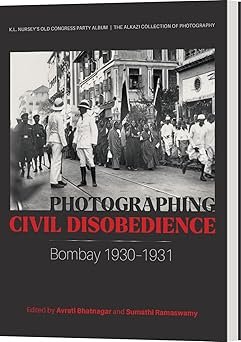
Photographing Civil Disobedience: Bombay, 1930–31 brings together an interdisciplinary conversation around a rare collection of documentary photographs compiled in a historical album titled Collections of Photographs of Old Congress Party—K.L. Nursey, held in the Alkazi Collection of Photography, New Delhi. The album features 245 black-and-white images that capture the extraordinary history of the Civil Disobedience Movement in Bombay (now Mumbai), when the city’s cosmopolitan streets came alive with anticolonial protests, processions, and propaganda. The essays in the volume engage with this remarkable visual archive to analyze and make visible the varied historical processes that animated and informed disobedient action and nationalist politics in colonial Bombay in the 1930s—from the leading role played by the desh sevikas, members of a nationalist women’s organization, to the violent crackdown of police lathis on non-violent demonstrators.
Photographing Civil Disobedience shows that anticolonial action in the city was deeply embedded in its urbanized social, cultural, and economic milieu, and dictated by the politics of gender. Moving the lens of analysis away from prominent leaders of the movement, the essays focus on the sea of ordinary people participating in public events and turning the streets of Bombay into sites of anticolonial and nationalist assertion as captured on camera. This remarkable visual history of radical collective disobedience, resistance and revolution centered on the power of the photograph will be of interest to scholars of gender and women’s studies, urban studies, screen and visual studies, consumer history, as well as the material history of colonial India.
