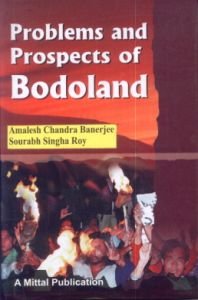
Problems and Prospects of Bodoland
Contents: Preface. I. Acquainting with Bodoland: 1. Introduction. 2. Bodo identity and Bodo accord. 3. The constitution and the memorandum of settlement. 4. Bodo territorial
Council Area and the administrative structure. II. Production and finance: 5. Agriculture and water management. 6. Industry. 7. Infrastructure. 8. Forest and tourism. 9. Financial structure. III. Human resource development: 10. Basic health and elementary education. 11. Women in Bodoland-status and empowerment. 12. Literature and culture. 13. Field study. 14. Suggestions and recommendations. Appendices. Bibliography. Index.
Bodo Territorial Area District (BTAD), popularly known as Bodoland come into being as a result of an agreement signed among the Bodo Liberation Tigers, Government of India and the Government of Assam on 10 February, 2003. The Agreement is the culmination of the protracted movement of the Bodo ethnic group for a separate state. Under the agreement an autonomous Council representing the different sections of the population was formed and a package of substantial amount of money was granted by the Central Government for development of the Bodo inhabited districts. The agreement under the 6 schedules of the Constitution of India confers upon the Bodo Council a series of special rights, which will be the guidelines of development of the area.
The study is the first of its kind regarding Bodoland and Bodo Movement. It captures the socio-economic status of the Bodo people through extensive field study of all four districts of Bodoland. The field survey was done under the sponsorship of Maulana Abul Kalam Azad Institute of Asian Studies. The study brings out the strong points of Bodo socio-economic status and makes a projection of Bodoland development based on these positive factors. The study examines how an ethnic aspiration can be productively channelised under the constitutional guarantee of sub-state format.
