Protest and the State in Eurasia and West Asia
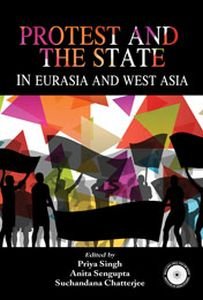
Contents: Introduction. The Construction of Protest Movements. 1. Evolution of protests in Tibet (1959-2008)/Claude Arpi. 2. The protest movement and political change in Tajikistan/Kamoluddin Abdullaev. 3. Water resource management in Central Asia: an issue of social conflict/Aidar Amrebayev and Aigul Akhanova. Moments, Imaginings and Movements: 4. Exploring the symbolic dimension of social protest: an analysis of public representations of opposition to Putin’s regime during the Moscow Protest Campaign of 2011-2012/Olga Malinova. 5. The politics of exclusion: rhetoric, symbolism and Gezi Park/Anita Sengupta. Protest and the State. 6. Gone with the wind or a tectonic change? A retrospective analysis based on the 2011 Israeli socio-political protest campaign/Tamar Hermann. 7. Economic demands and sociocultural identities: the “social justice” protests in Israel/Zeev Rosenhek and Michael Shalev. Movements and Counter-Movements. 8. Amid empire states: protest movements in the transforming Middle East/Fatemeh Sadeghi. 9. Ruminations on the characteristics and consequences of political protests in the Arab World/Ranjit Gupta
The twenty-first century has witnessed disaffection and protest across Eurasia and West Asia, triggering debates questioning the state of governance as well as looking at a redefinition of the ‘arc of crisis.’ By and large, there have been two major viewpoints, one which emphasises the aspect of ‘failed states’ and the other that focuses on technology as the prime instigator and motivator for the protests. Even as the Arab Uprisings are commonly acknowledged as an upshot of a succession of protests as well as the “colour revolutions” across Eurasia and West Asia, the after effects have been incessant with the Maidan in Ukraine and intermittent protests in Turkey.
The causative factors have been as diverse as climate change and its adverse impact, economic inequalities fed by a process of globalisation which caters to certain sections of society, social grievances of marginalised sections who feel politically, socially or culturally deprived and a general failure to address critical issues in an apt way. While the nature of the protests has been as varied as the reaction of authorities to the protest, there has been a tendency to review the replication of the protests across states in the region. The world today is increasingly observing and partaking in local and global acts of protest and solidarity that entail visual, aural, and behavioural articulations by demonstrators as effective ways of making claims, reclaiming spaces, and condemning invasive situations.
The volume analyses relations between the state and such protests by exploring the construction of protest movements, and probing the background, nature and specificity of dissent. Protest movements and counter-movements have been examined and analysed. The purpose is to understand and interpret the moments and episodes associated with movements, capturing, disseminating and transmuting the images and symbols of protest. Chapters in the volume enquire about and debate on whether contemporary protesters are consolidating upon and intensifying prior repertoires of dissent.
