RAVIKIRTI: Illuminating the Great Traditions of Harappan Culture (Festschrift in Honour of Dr. R.S. Bisht, Padma Shri Awardee)
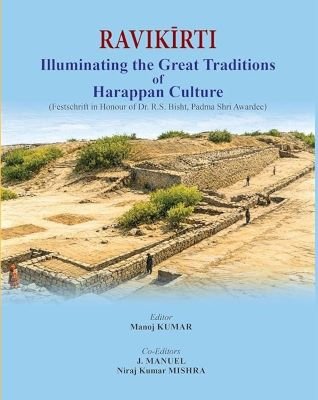
Ravikirti, the felicitation volume, aims to honour the ‘fame of Ravi’ (Ravindra Singh Bisht) for his unwavering dedication and passion for Indian Culture, particularly the Harappan Culture. It centres exclusively on Harappan archaeology, the field where Dr. Bisht earned prominence through his groundbreaking discoveries, making him one of the foremost Harappan archaeologists globally. His research works not only led to many firsts in Harappan archaeology but also included a proposal to adopt the term “Harapenia” for the entire Harappan territory (during personal discussion).
This volume is organized into three parts: Reminiscence, Research Articles, and Dholavirian, in which the Dholavirian provides a summary of archaeological activities and personal experiences from those involved in the Dholavira excavations, a site that marks a significant milestone in Dr. Bisht’s career. Comprising 31 research papers, the second part of volume is divided into 07 sections - I. Script, Language, and Inscriptions; II. Environment, Geography, and Ecology; III. Economy, Technology, and Agriculture; IV. Socio-Cultural and Religious Life; V. Intercultural Connection; VI. Recent Fieldworks; and VII. Urban Planning, Settlement Patterns, and Architecture. The seven articles of the first section are especially significant as they tackle the vital challenge of deciphering and properly understanding of the Harappan script, which is essential for unlocking the intellectual accomplishments of the first urban culture of South Asia. The research papers for the other sections are notable too, as they illuminate the important facets of the Harappans in view of recent discoveries. These findings highlight a society that successfully harmonized advanced technology with ecological awareness and rich cultural traditions. This balance is particularly evident in their city planning, which incorporated sustainable practices; their trade regulations and methods of communication, which fostered representation and inclusivity. These elements not only shaped their own civilization but also had a lasting impact on neighbouring cultures. Remarkably, many characteristics of Harappan Culture, such as urban planning techniques, architectural style, trade practices, social and religious practices, continue to resonate in the societies across South Asia today, underscoring the enduring legacy of this great civilization.
