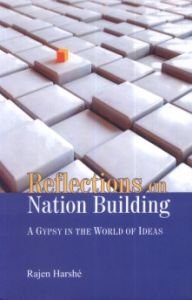
Reflections on Nation Building : A Gypsy in the World of Ideas
Contents: Preface. 1. Gypsy. I. Inspiring thinkers and their praxis: 2. Remembering Gandhi. 3. Nehru: a critical tribute. 4. Sufferings and sacrifices towards emancipation: biographical essence of Tilak and Mandela. 5. Self realisation through devotion to work: reflections on Savta Mali. II. Understanding history and reflections on traumatic historical events and processes: 6. Critical reflections on daunting issues in the study of history. 7. Post-war partitions: a reappraisal. 8. The Berlin wall as a construct and a metaphor. 9. Alienation in the emerging and post-industrial world. III. Perspectives on education: global and anti-colonial: 10. Rethinking J. Krishnamurtis ideas on education. 11. Revisiting Frantz Fanon: race and the colonial world in Africa. IV. Institution/nation building in India: 12. Working for a bright present. 13. Consolidating Democracy and India through discourses on duties. 14. Healing fractured India by nurturing young minds. 15. Rising like a phoenix by energising the youth. 16. Bringing India back home in the universities. 17. Resurgent youth as active agents of change. 18. Globalising world and universities in India. 19. Recasting Indo-African partnership in the 21st century. 20. Golden threshold. Bibliography. Index.
This unusual collection of essays dwells upon a wide variety of themes that essentially reflect, overtly or subtly, on the processes of nation building. As a result, the author traverses like a gypsy in the world of ideas to allow his soul to express itself before his readers. In this process, the book reveals author\'s ever maturing understanding of a few memorable poems, the role of inspiring leaders, metaphysical essence of life and society, traumatic events and processes in history, the human quest towards institution/nation building and the likely role of younger generations in shaping India of tomorrow. A gypsy that is hiding deep down in the author\'s mind continuously makes him restless within the narrow confines of the known world and wandering in the world of ideas appears to be an obvious outcome of his restlessness.
In the context of nation building the book sheds a new light, with some personal touch, on the contributions of leaders like Gandhi, Nehru, Tilak and Mandela. Subsequently it moves on to grasp an essence of life through the teachings of Savta Mali, a thirteenth century saint poet, with metaphysical depth, from Maharashtra. In addition to exploring the daunting tasks in understanding and interpreting history, the book analyses traumatic events and processes in history, like partition and erection of the Berlin wall. While perceiving any trauma across time and space the author unveils the significance and impact of the notion of alienation in emerging and post industrial society by discussing a moving poem of Kusumagraj in Marathi, on the one hand, and writings of a few celebrated existentialist thinkers like Albert Camus, on the other hand.
After highlighting the global and anti-colonial perspectives on education of J. Krishamurti and Frantz Fanon, respectively, the author handles themes related to institution and nation building. He underlines the significance of duties, his vision of India, challenges before younger generations amid growing frustrations on account of mounting socio-economic inequalities, the state of higher education in the global sing world and changing requirements of foreign policy in the process of nation building. The book ends with a semi autobiographical essay that virtually sketches a partial biography of two major educational institutions, namely, universities of Hyderabad and Allahabad. Owing to its varied intellectual concerns and lucid style the book is eminently readable. Every thinking and sensitive mind, especially students of literature, philosophy and social sciences would be benefitted by reading it. (jacket)
