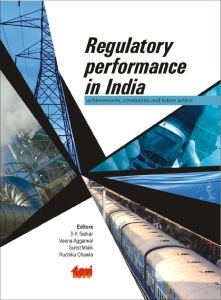
Regulatory Performance in India: : Achievements, Constraints, and Future Action
Contents: 1. Creating a competitive environment. 2. Enabling private participation in infrastructure Services. 3. Mechanisms for addressing USO. 4. Best practices and innovation in tariff regulation. 5. Facilitating consumer involvement in the regulatory process. 6.Consumer involvement in the regulatory process: power sector. 7. Consumer involvement in the regulatory process: a case study of KERC. 8. Facilitating consumer involvement in the regulatory process in the telecom sector. 9. Session summary. 10. Panel discussion: Approaches for assessing regulatory impact . 11. Background paper. 12. Need for regulatory impact assessment. 13. Understanding the process behind reform and regulation in India. 14. Session summary. 15. Concluding session. 16. Concluding comments. List of Speakers.
"India has had several years of experience with regulatory reforms and establishment and functioning of independent regulatory bodies, especially in the infrastructure sector. An institutional innovation of this nature requires regular appraisal and assessment to evaluate its effectiveness. This was precisely the objective of the two-day conference organized by TERI in 2006 on \'Regulatory performance in India: achievements, constraints, and future action\'. Amongst the infrastructure sectors, focus was on power, oil and gas, telecom, water, and transport sector. The event sought to evaluate the working of regulatory commissions/government ministries on their effectiveness in ushering competition, encouraging private participation, rationalizing and re-balancing tariffs, and involving consumers in the regulatory process. There were deliberations on the need and kind of techniques suitable for evaluating the impact of regulations in India.
This volume contains the proceedings of the six plenary sessions of the conference. It covers in detail the background papers, presentations, and subsequent discussions held after each session. The deliberations not only covered the Indian regulatory experience but also highlighted learning from developed/transition economies and, therefore, hold relevance for readers in other countries, especially those in the South Asian region. This volume serves as a reference on the regulatory achievements and constraints and provides some thoughts on the future course of reforms in the infrastructure sector.
Key Features:
• The book presents state-of-the-art technologies for controlling air pollution.
• The write-up is supported with various tables and figures for easy
comprehension.
• Solved examples are also part of the chapters.
• Revision questions along with solutions are also given in the book.
• The language of the book is simple and lucid for easy comprehension."
