Research Methods for History
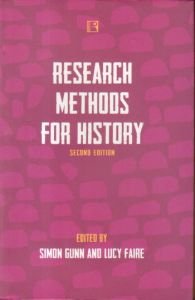
Contents: Preface. 1. Introduction: why bother with method?/Simon Gunn and Lucy Faire. I. The Essentials: 2. Working with/In the archives/Michelle T. King. 3. Approaching visual materials/Ludmilla Jordanova. 4. Material culture/Allan Mayne. 5. Landscape and place/Jo Guldi. II. Researching individuals and Groups: 6. Collective biography/Krista Cowman. 7. Life stories and historical analysis/Alistair Thomson. III. Quantitative and qualitative analysis: 8. GIS, spatial technologies and digital mapping/Keith Lilley and Catherine Porter. 9. Document to database and spreadsheet/R.J. Morris. 10. Digital research/Bob Nicholson. IV. Deciphering meanings: 11. Reading language as a historical source/Fulie-Marie Strange. 12. Analysing behavior as performance/Simon Gunn. V. Rethinking categories: 13. Ethics and historical research/William Gallois. 14. Time, temporality and history/Prashant Kidambi. Index.
Historians have become increasingly sensitive to social and cultural theory since the 1980s, yet the actual methods by which research is carried out in history have been largely taken for granted. Research Methods for History encourages those researching the past to think creatively about the wide range of methods currently in use, to understand how these methods are used an what historical insights they can provide.
This updated new edition has been expanded to cover not only sources and methods that are well-established in history, such as archival research, but also those that have developed recently, such as the impact of digital history research. The themes of the different chapters have been selected to reflect new trends in the subject, including landscape studies, material culture and ethics. Every chapter presents new insights and perspectives and open researchers minds to the expanding possibilities of historical research. (jacket)
