Right of the Line: The Presidents Bodyguard
Contents: Foreword. Preface. 1. The presidents horsemen/T.S. Mundi. 2. In the service of the Governor-general/Rana T.S. Chhina. 3. In the service of the president/Rana T.S. Chhina. 4. All the President’s men/Rana T.S. Chhina. 5. All the President’s Horses/Yashaswini Chandra. 6. Afterword/Anil Khosla. Appendices. Bibliography. Index.
For Centuries, the head of the state, who was usually a monarch, was protected by a specially chosen band of warriors renowned for their skill at arms and prowess in battle. These chosen few in time came to be known as the guards of the bodyguards and were the elite of the armies from amongst which they were selected. They protected the person of the monarch and members of the royal family, both in times of war and peace. It is on the basis of their special relationship with the monarch that they were also known as household troops and as such occupied pride of place in the order of march at the head of the army along with the sovereign.
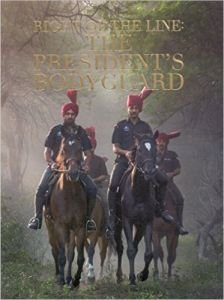
In India, the President’s Bodyguard (PBG) performs the duties of the household cavalry of the Indian head of the state. Based within the precincts of the President’s Estate in the heart of New Delhi, it is not merely a ceremonial unit. Its personnel, required to be at least six feet in height, are professional soldiers, who combine cavalry tradition and ceremonial elan with their duties as trained paratroopers and members of the Indian Armoured Corps. Apart from its connection with the head of the state, the PBG is also the oldest regiment in the Indian Army with a lineage dating back to 1773. As such it is the most senior unit of the Indian Army and occupies pride of place in the regimental order of precedence to stand at the right of the line on any ceremonial parade or order of March.
This book traces the history and ethos of this remarkable regiment. It is part of a series of volumes documenting different aspects of the rich cultural, social and historical legacy of the Rashtrapati Bhavan as a national institution. (jacket)
