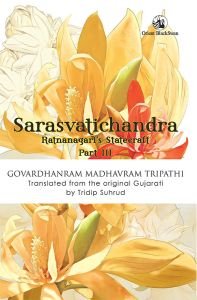
Sarasvatichandra Part III: Ratnanagari’s Statecraft
Contents: Introduction. Preface I. Preface II. 1. Sundargiri. 2. Maniraj and Vidya Chatura’s Family in Manoharpuri. 3. News from Bombay: Dhurtalal’s Machinations. 4. News from Suvarnapur: The Guilty Son of the Karbhari. 5. In the Presence of Vishnudas. 6. A Discourse on the Philosophy of the Manifest and the Unmanifest: Dream, Awakening,Dream.7. Kings and Ministers of Ratnanagari. 8. Mallaraj and His Jewels. 9. Mallaraj’s Concerns. 10. Mallaraj’s Mani and His Initiation into Statecraft. 11. The First Surge of Foreign Rule . 12. New Chapters and New Histories. 13. Mallaraj’s Retirement and Maniraj’s Youthful Reign. 14. Maniraj’s Sorrow and the Vision of His Father. 15. A Look Back at Sarasvatichandra and Kumud.
A novel of epic proportions written in four parts from 1887 to 1901, Sarasvatichandra is both the enactment and embodiment of the life philosophy of one man, and his sole mission.
Part III, Ratnanagari’s Statecraft, details the efforts of Maniraj, the enlightened ruler of the princely state of Ratnanagari, and his able minister, Vidya Chatura, to create a responsible and inclusive polity in times of decay and change. Although feudal, Ratnanagari has survived British expansion because of the strength and vision of its rulers. With rare courage and candour, Tripathi deliberates on the impact of British rule in the context of the 1857 Revolt, even as he conducts a philosophical enquiry into the nature of governance. We also travel with Sarasvatichandra—rescued from death by ascetics in Part II—to a remote monastery in the high mountains of Sundargiri, headed by the enigmatic and erudite Swami Vishnudas.
The novel holds up a fascinating mirror to Gujarati society and life in the princely states against the backdrop of pre-independent India, in transition at the turn of the nineteenth century—culturally, politically and ideologically. Before Gandhi, arguably no other work has so profoundly influenced the ethos and imagination of Gujarat as Sarasvatichandra. Part IV, also translated by Tridip Suhrud, an acknowledged scholar of nineteenth- and twentieth-century Gujarat, is forthcoming. (jacket)
