Science and Conservation of Wildlife Populations
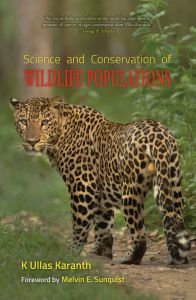
Contents: Foreword. Preface. 1. Wildlife population monitoring: a conceptual framework/James D. Nichols and K. Ullas Karanth. 2. Estimating demographic parameters/Ken H. Pollock, James D. Nichols and K. Ullas Karanth. 3. Many ways of skinning a cat: tools and techniques for studying wild felids/K. Ullas Karanth, Paul Funston and Eric Sanderson. 4. The shrinking ark: patterns of large mammal extinctions in India/Krithi K. Karanth, James D. Nichols, K. Ullas Karanth, James E. Hines and Norman L. Christensen. 5. Monitoring carnivore populations at the landscape scale: occupancy modelling of tigers from sign surveys/K.Ullas Karanth, Arjun M. Gopalaswamy, N. Samba Kumar, Srinivas Vaidyanathan, James D. Nichols and Darry I. MacKenzie. 6. Estimating distribution and abundances of elephant populatons from sign surveys at the landscape scale using occupancy modelling: field methods/K. Ullas Karanth, N. Samba Kumar and M.S. Nishant. 7. Estimating tropical forest ungulate densities from sign surveys using abundance models of occupancy/Arjun M. Gopalaswamy, K. Ullas Karanth, N. Samba Kumar and David Whyte Maconald. 8. Estimating density and abundance of elepahants from sightings along line transects: field methods/Simon Hedges, N. Samba Kumar, M.S. Nishant and K. Ullas Karanth. 9. Measuring Indian giant squirrel (Ratufa Indica) abundance in Southern India using distance sampling/Devcharan Jathanna, N. Samba Kumar and K. Ullas Karanth. 10. Non-invasive survey methods for assessing tiger populations/K. Ullas Karanth and James D. Nichols. 11. Evaluation of non-invasive genetic sampling methods for estimating tiger population size/Samrat Mondol, K. Ullas Karanth, N. Samba Kumar, Arjun M. Gopalaswamy, Anish Andheria and Uma Ramakrishnan. 12. Estimating tiger abundance from camera trap data: field surveys and analytical issues/K. Ullas Karanth, James D. Nichols and N, Samba Kumar. 13. A tiger cannot change its stripes: using a three-dimensional model to match images of living tigers and tiger skins/Lex Hiby, Phil Lovell, Narendra Patil, N. Samba Kumar, Arjun M. Gopalaswamy and K. Ullas Karanth. 14. Estimation of demographic parameters in a tiger population from long term camera trap data/K. Ullas Karanth, James D. Nichols, N. Samba Kumar and Devcharan Jathanna. 15. Estimating abundance and other demographic parameters in elephant populations using capture-recapture sampling: field practices/K. Ullas Karanth, N. Samba Kumar, varun R. Goswami, James D. Nichols and Simon Hedges. 16. Big cats in our backyards: persistence of large carnivores in a human dominated landscape in India/Vidya Athreya, Morten Odden, John D.C. Linnell, Jagdish Krishnaswamy and K. Ullas Karanth. 17. Factors influencing densities of striped Hyenas (Hyaena hyaena) in arid regions of India/Priya Singh, Arjun M. Gopalaswamy and K. Ullas Karanth. 19. Counting India's wild Tigers reliably/K. Ullas Karanth, Arjun M. Gopalaswamy, N. Samba Kumar, Mohan Delampady, James D. Nichols, John Seidensticker, Barry R. Noon and Stuart L. Pimm.20. India's tiger counts: thelong March to reliable science/K. Ullas Karanth. 21. Bringing the Tiger back from the brink-the six percent solution/Joe Walston, John G. Robinson, Elizabeth L. Bennett, Urs Breitenmoser, Gustavo, A.B. da Fonseca, John Goodrich, Melvin Gumal, Luke Hunter, Arlyne Johnson, K. Ullas Karanth, Nigel Leader Williams,Kathy MacKinnon, Dale Miquelle, Anak Pattanavibool, Colin Poole, Alan Rabinowitz, James L.D. Smith, Emma J. Stokes, Simon N. Stuart, Chantavy Vongkhamheng and Hariyo Wibisono. 22. Sinks as saviors: why flawed inference cannot assist tiger recovery/K. Ullas Karanth, Arjun M. Gopalaswamy. Krithi K. Karanth, John Goodrich, John Seidensticker and John G. Robinson. 23. Trasnlation as a tool for mitigating conflict with leopards in human-dominated landscapes of India/Vidya Athreya, Morten Odden, Hon D.C. Linnell and K. Ullas Karanth. 24. A tiger in the drawing room/K. Ullas Karanth and Krithi K. Karanth. 25. Kudremukh iron ore Company Limited (KIOCL): The deaht knell and beyond-case analysis I /K. Ullas Karanth. 26. Free to move: conservation and voluntary resettlements in the western ghats of Karnataka, India/K. Ullas Karanth and Krithi K. Karanth.
Conservationists might set out with very different objectives: perservation and recovery of rare and threatened species-as with rhinos or bustards, sustaining a steady supply of useful products for human use-as with fisheries, or even eliminating threats to human life or livelihoods as in the case of rodent pests or man-eating tigers. None of these objectives, however, can be effectively met without a clear understanding of how wild populations of these species function. The necessary knowledge can come only from the applciation of rigorous science, which involves sampling modeling and estimating animal populations.
Even with such reliable knowledge in their armory, conservationists must face social challenges in application of this science on the ground and in the policy arenas, in which not everyone may share their goals or values. This volume contains 26 articles by the author written in collaboration with other leading biologists, quantitative ecologists and conservationists. It boldly explores a complex terrain that spans ecological theories to social practices. It is a useful guide for those practicing science-based conservation.
