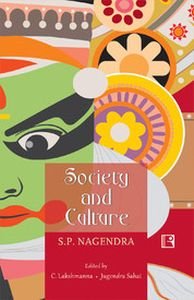
Society and Culture: S.P. Nagendra
Contents: 1. Moral and ritual foundations of ancient Indian society in the age of Sutras and early Smiritis. 2. Historiography of culture. 3. Homo Hierarchicus: some comments. 4. The theory of development: a sociological critique. 5. Natures's metropolis or nature's necropolis? The city and urbanization. 6. Towards a cultural policy in India: can culture be planned? 7. D.P. Mukherji as a sociologist: centenary Shradhanjali. 8. The concept of ritual in retrospect: a critical review. 9. changing profile of women in India: some reflections. 10. Rethinking development in relation to the scheduled castes. 11. Eradication of poverty: rhetoric and reality. 12. A sociological perspective on the development of eastern UP. 13. The traditional theory of caste. 14. Dimensions of development. 15. Social vision with reference to Gandhi. 16. Human resource and industrial development. 17. Enrichment of life through science and religion. 18. Value crisis and we. 19. Cultural deprivation and community dynamics. 20. Indian social diversity: a boon or bane. Index.
This commemorative volume of Professor S.P. Nagendra consists of some of his important and seminal contributions to sociology. These articles broadly are on traditions and their moral and ritual foundations, culture and its policy implications, development and its important ramifications and his glowing tribute to his outstanding teacher, Professor D.P. Mukerji, the doyen among the Indian sociologists.
For Nagendra, the ancient Indian society is the nearest approximation to what can be considered as the normal civilization. It rests on principles which guided the hierarchical ordering of the traditional society. The social change in the traditional society is from one order to the other, similar to those in the life organism. On culture, Nagendra employs Dielthey's concept of interpretive understanding to fully comprehend the different concepts of culture. Likewise, there are many significant observations on other issues which sociologically are significant, such as the discussion on tradition and modernity and others.
This book will be invaluable for both academics and the lay readers to appreciate the critical issues in modern Indian society. (jacket)
