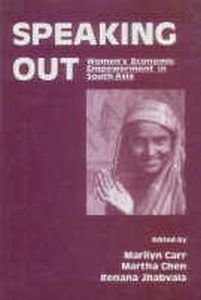
Speaking Out : Womens Economic Empowerment in South Asia
Contents: Preface. I. Introduction/Marilyn Carr, Martha Chen and Renana Jhabvala. 1. Women and poverty in South Asia. 2. Approaches to women’s empowerment. 3. Experiences of NGOs and POs in working with women. 4. The purpose of the research. 5. The research project. 6. Research questions. 7. Methodology. 8. Selection of organizations. 9. Selection of field sites. 10. Summary of the case studies. II. Case studies: 1. Village and community organizations: Gathering the second Harvest: Aga Khan rural support Programme (AKRSP) in Northern Pakistan/Abinta Malik and Sandra Kalleder. 2. Transforming women’s economies: Bangladesh rural Advancement Committee (BRAC)/Gul Rukh Selim. 3. Demanding accountability: Proshika in Bangladesh/Lamia Rashid and Shahabuddin. 4. Co-operatives: like my mother’s house: women’s thrift and credit; Co-operatives in South India/Nandita Ray and D.P. Vasundhara. 5. Rural women manage their own producer co-operatives: Self Employed Women’s Association (SEWA)/Banaskantha Women’s Association in Western India/Sharit Bhowmik and Renana Jhabvala. 6. Women’s Banks: women banking for success: Women’s Development Federation (WDF) in Sri Lanka/W.M. Leelasena and Chitrani Dhammika. 7. Unionization: Empowering marginalized workers: unionization of tobacco workers by the Self Employed Women’s Association (SEWA) in Kheda, Gujarat/Sharit Bhowmik and Meena Patel. 8. A struggle within a struggle: the unionization of women in the informal sector in Tamil Nadu/Geetha Ramakrishnan. 9. Lessons learned/Marilyn Carr, Martha Chen and Renana Jhabvala. References.
"Throughout South Asia, women have been organizing to gain access to credit, training, technologies and other inputs required for creating successful enterprises. In the process, they have increased not only their earning capacities but have overcome many barriers to women’s participation in economic development. This book documents the experiences of seven NGOs in India, Pakistan, Bangladesh and Sri Lanka who have been successfully working with rural and urban poor women to evolve strategies for bringing about women’s empowerment.
Going beyond the normal descriptive accounts, the case studies provide a wealth of new insights on how changes are occurring at the grassroots level. The contributors draw lessons from these vivid first-hand experiences to show how women are gaining increased access to and control over economic resources and how this, in turn, has led to far-reaching socio-cultural and political changes at the level of the individual, family, community and the market place. They also show how women are building organizations which are becoming ever more autonomous and self-reliant.
Overall, this book provides ample evidence that women’s empowerment is actually taking place on a significant scale in South Asia and that this is having a noticeable impact on levels of poverty and well-being. It constitutes an invaluable resource for students of development and women’s studies and for development planners, grassroots workers and women’s organizations." (jacket)
