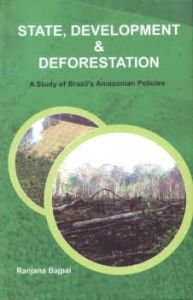
State, Development and Deforestation : A Study of Brazil\'s Amazonian Policies
Contents: 1. Introduction. 2. Brazilian amazon: a geographical background. 3. Development and environment policies. 4. Environmental threats. 5. Regional and international cooperation. 6. Sustainable alternatives. 7. Conclusion. References. Index.
"The developing nations and some of them with extremely fragile ecosystems are facing serious development environment paradox. After having closely followed the conventional western development model, the developing economies have had to pay serious socio-environmental costs of this development process. Not only have they carried the burden of degrade lands in the rural areas, deforestation of their virgin forests, but also poor air quality, crisis of safe drinking water, urban slums, congestion, rising unemployment and social strife among various groups. Much worse, most of this development is economically unviable and unsustainable in the long run.
The environmentalists world over have identified some global environmental hot-spots (critical areas in terms of development environment crisis). A prominent among these is Brazil\'s Amazon region containing the world\'s largest remaining tropical rainforests and a rich biodiversity. The region has been in the limelight of international attention with increasing deforestation rates ever since 1970s; vast forest fires of 1987; and murder of a famous rubber-tapper, environmentalists Chico Mendes in the Brazilian province of Acre. Thus the problem of deforestation kin Brazilian Amazon acquired the status international environmental crisis. Over the past two decades the deforestation in Brazilian Amazon is increasingly being linked to global warming and loss of its rich biodiversity. Therefore the international community is closely watching the policies of the Brazilian government in its Amazon region. The region faces a disturbing environmental crisis as the attempts to \'develop\' it unfold a new chapter everyday.
The environmental problems of international significance, like those related to forest loss in Brazilian Amazon, are trans-national and individual nations or for that matter, any regions are not able to protect themselves from the impacts of international environmental problems. These problems have become a common potential threat to every individual and to every country on earth. The fact that the impacts of these environmental problems are not country specific has made people increasingly aware of the ecological interdependence of our planet and also that collective efforts are needed on part of the international community to resolve these global environmental problems.
This book attempts to explore the development issues and environmental problems of the Amazon region of Brazil in the present context. The book begins with an analysis of the concepts of development and sustainability. It provides an indepth and critical analysis of the development and environment policies of the successive Brazilian regimes-both military and civilian. It also addresses various environmental threats in the region arising out of decades of geopolitical thinking and predatory development policy as well as poorly implemented environmental codes. At the same time regional and international efforts to evolve a strategy for sustainable development have also been discussed.
This book especially caters to those interested in environmental challenge in developing countries. This study has special importance for those interested in tropical forest management. While the natural wealth of these forests is hard to resist for any developing country, less attention is being paid to environmental services like carbon storage, checks in soil erosion, balancing precipitation and restoring overall ecological balance. The choices are for the respective countries to make.
The book is an outcome of detailed research drawing upon a rich primary and secondary source materials in Portuguese from Brazil\'s official sources and reports published by international agencies like world bank and UN as well as other research organizations conducting research on this geo-politically sensitive region. It is a pioneering work on this region with a perspective that includes its geography, environment, politics and social dimensions."
