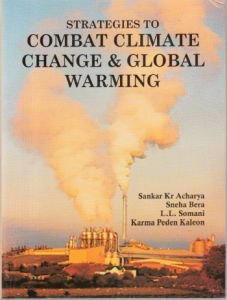
Strategies to Combat Climate Change and Global Warming
Contents: Preface. 1. Climate change. 2. Global Warming. 3. IPCC reports and observation. 4. Climate change and hill ecosystem. 5. Climate change and agriculture. 6. Climate change and biodiversity. 7. Climate change and forest ecosystem. 8. Climate change and water resources. 9. Climate change and fisheries. 10. Climate change, sea level rise and coastal ecosystem. 11. Climate change and hill ecosystem. 12. Climate change migration and conflict. 13. Climate change and tourism. 14. Enrollment of women in climate change mitigation. 15. Socio-ecological strategy to combat climate change. 16. Communication strategy to mitigate climate change. 17. Agricultural extension strategy in climate change mitigation. 18. IPCC observation on public health and global warming. 19. Empirical study 1. 20. Empirical study 2. 21. Empirical study 3. 22. Clean development mechanisms (CDM). 23. Literature review. Bibliography. References.
The brunt of climate change is becoming harsher and more dominant especially on agriculture, human and animal health, on life and livelihoods of different Diaspora. The IPCC reports are revealing that the rate of climate change will go faster and pervading than it was originally estimated. Millions of people living on coastal ecosystem will turn homeless and jobless since the sea level rising will be happening at a much faster rate than it was originally predicted. The melting of snowline and their faster retreat over mountain terrains will leave the snow fed rivers more and more sickly and the river fed agro ecosystem will become more and more fragile posing a threat on food security and social equilibrium.
The one degree Celsius rise in night temperature will add eighteen per cent decline of wheat productivity and 12 per cent decline in rice productivity as well. The ICAR has already initiated a series of research endeavors for generating innovation at National Initiative on Climate Resilient Agriculture (NICRA), towards achieving climate resilient agriculture to cope up with the change scenario and mitigate the risk. The book entitled Strategies to Combat Climate Change and Global Warming has been a unique endeavour to accommodate in a precise and encapsulated manner, the basics of climate change and its impact on diverse areas like agriculture, fisheries animal health, biodiversity, health etc. spreading over 23 chapters and the strategies to combat it. The three empirical studies are also appended to enrich the text and make it more attractive and effective to students, scholars, faculties and policy makers from across the disciplines. (jacket)
