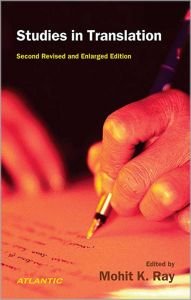
Studies in Translation
Contents: Preface. 1. Translation: its brief history and theory/Suka Joshua. 2. Literary translation: its importance, ways and difficulties/Mallikarjun Patil. 3. Translation theory/R. Shanti. 4. Translation theory/K. Krishnamurthy. 5. Problem of translating poetry/Umashankar Joshi. 6. Problems of translation/Bijay Kumar Das. 7. The anxiety of authenticity: reflections on literary translation/K. Ayappa Paniker. 8. The politics of postcolonial translation/Harish Trivedi. 9. What translation really means/Basudeb Chakraborty. 10. Translation or transcreation/Anjana Tiwari. 11. Reconstructing the tower of Babel: equivalence in translation: a rare case study/Rama Kundu. 12. A comprehensive model of translation criticism/Sunil R. Sawant. 13. Nineteenth century Marathi literary polysystem/Sunil R. Sawant. 14. A note on dryden's views on translation/Mohit K. Ray. 15. Matthew Arnold on translation/Prasenjit Chattopadhyay. 16. Tagore in translation: a case for revaluation/Subhas Sarkar. 17. Demystifying translation/Niranjan Mohanty. 18. The limits of translation/Bijay Kumar Das. 19. Perspectives on translation: down the centuries/Rama Kundu. Appendix-- on translating homer/Matthew Arnold. Contributors.
"The essays included in the anthology offer a broad, luminous spectrum of translation studies. During the last three decades translation studies or translatology has developed into an independent discipline or rich potentials leading to the establishment of full-fledged departments in many universities.
The history of literary translation in the west is, by and large, the history of two opposing views--freedom versus fidelity--what fidelity consists and how much freedom a translator can claim. The more conservative school believes that a translator is a traitor if his translation is not literal while the advocates for freedom hold that in literary translation, paradoxically, a translator must be a traitor to the letter in order to be loyal to the spirit because, they insist, the soul is more important than the body.
In addition to giving a brilliant exposition to the history, theories, and problems of translation, the essays also assiduously examine translation in practice, revealing in the process subtle nuances and complexities involved in the act of translation.
Anybody interested in the study of translation will find the book intellectually stimulating and practically useful." (jacket)
