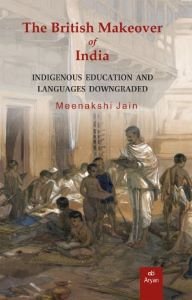
The British Makeover of India: Indigenous Education and Languages Downgraded
Contents: Preface. Section A: Fluctuating Company Stance on Indigenous Education – To Applaud or Uproot? 1. Introduction. 2. Early Beginnings. 3. Some Accounts of Indigenous Education. 4. An Evangelical Blueprint for India- Anglicization and Christianization. 5. Initial Endorsement of Indigenous Education Systems by East India Company. 6. Reversal of 1824 – Enter James Mill. 7. Bentinck and Macaulay – A Calculated Turn. 8. Declaration of Official Policy in Favour of English. 9. The Mills and the Education Debate. 9. Wood’s Education Despatch – A Triumph of Missionaries and Anglicists. Section B: Missionaries Enter Field of Education. 11. Early Company Policy on Missionaries. 12. Education as a Tool of Proselytization. Section C: Reports from the Provinces. 13. Madras Presidency Endorsed Vernacular Education. 14. Bombay Presidency Approved Vernacular Education. 15. William Adam’s Recommendations for Vernacular Education in Bengal Presidency. 16. North-Western Provinces and the Punjab – Growing Support for Christianization. Section D: The Persian/Urdu/Hindi Controversy. 17. Urdu – An Artificial Construct. 18. Hindi versus Persian/Urdu. Appendices. References. Index.
Long centuries before the Common Era, the commitment, continuity, and participation in the transmission of indigenous knowledge was apparent from several sources. An early important agency for the communication of literal and specialized education was the family. There were also references to teachers of noble character, gurus, who imparted knowledge in their ashrams. Later, the presence of organized institutions could be gleaned from temple colleges and mathas of acharyas.
At the beginning of the nineteenth century, indigenous systems of education were in a reasonably good state. British educational surveys, beginning with that of the Madras Presidency under the direction of Governor Thomas Munro, confirmed that.
The colonial state made systematic attempts to undermine the self-sufficient indigenous education systems. Interestingly, a blueprint for the Christianization and Anglicization of India was presented as early as 1792 by the Evangelical, Charles Grant. Thomas B. Macaulay implemented the scheme some four decades later.
While most Company officials in India emphasized the need to retain indigenous vernacular systems, a small group in London and Calcutta pressed for English education. Complicating matters was the growing presence of missionaries, and their determination to proselytize. The Indian resistance to the blandishments of the Company and missionaries was the true story of education in colonial times.
Alongside was the battle against Persian and Urdu by proponents of Hindi, who regarded it as the bearer of indigenous cultural heritage. They viewed the promotion of Persian and Urdu as "the total displacement of the national and traditional for one which is strange, foreign, and uncongenial."
