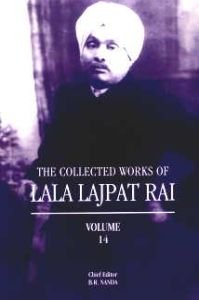
The Collected Works of Lala Lajpat Rai, Vol. 14
Contents: Foreword. "Unhappy India": Preface. Introduction. 1. The argument. 2. The light through the ages. 3. The light that failed. 4. Learning and earning--and hard headed Americans. 5. A counsel of perfection. 6. History of compulsory primary education. 7. Why is light denied? 8. The Hindu caste system. 9. The untouchable--his friends and his exploiters. 10. Less than the Pariah. 11. Less than the Pariah (concluded). 12. Woman in India--a retrospect. 13. Woman and the new age. 14. Early to marry and early to die. 15. The Hindu widow. 16. The Devadasi. 17. Schooling, free of charge. 18. The sex urge in the west. 19. A present to Mr. Winston Churchill. 20. Muck-rakers whom we know. 21. The hygiene of the Hindus. 22. Why the cow starves. 23. India--home of plenty. 24. India--Home of stark want. 25. Poverty--the rock bottom physical base of India\'s ills. 26. Some aspects of the drain today. 27. Some aspects of the drain today (concluded). 28. Divide Et impera\'. 29. \'The sons of the prophet\'. 30. Britishers on British rule. 31. The story of the reforms. 32. Cumbrous, complex, confused system. 33. India--a world-menace. On "Mother India": 1. Winston Churchill on "Mother India". 2. History as she wrote. 3. Katherine Mayo\'s political motive. On "Unhappy India": 1. To G.D. Birla. 2. To G.D. Birla. 3. To B.W. Huebsch. 4. To G.D. Birla. 5. To G.D. Birla. 6. To J.T. Sunderland. 7. To B.W. Huebsch. 8. Disease and its cure. 9. Tom Johnston\'s socialism. Chronology. Index.
"Lala Lajpat Rai was one of the outstanding leaders of modern India, a contemporary of Dadabhai Naoroji, Tilak, Gokhale and Gandhi. His public life spanned the last decade of the nineteenth century and the first three decades of the twentieth century. He practised law at the Lahore Chief Court and built up a lucrative practice, but was drawn very early into public activities pertaining to religious, educational and social reforms and then into nationalist politics. Lajpat Rai was one of the foremost leaders of the Indian National Congress. His arrest and deportation without trial to Burma in 1907 created a great sensation in India. He spent the war years (1914-18) in the United States propagating the Indian case for self government. He returned to India in 1920 and had the honour of presiding over the Calcutta Session of the Indian National Congress which approved of Gandhi\'s campaign for non cooperation with the government. He was deputy leader of the Swaraj Party in the Central Legislative Assembly and played a prominent role in provincial as well as national politics in the 1920s. While leading a demonstration against the Simon Commission at Lahore in 1928 he received injuries in an assault by the police which hastened his death.
The fourteenth volume in the series is mainly the reprint of Lajpat Rai\'s Last major work Unhappy India. In 1927 when Lajpat Rai was in London, Miss Katherine Mayo\'s muckraking Mother India appeared. The book constituted a wholesale and indiscriminate vilification of Indian civilization and character by a foreign journalist. Aptly called a "drain inspector\'s report" Gandhiji, Mother India created quite a Stir in India as well as in Britain.
Lajpat Rai was convinced that the publication was a part of the unscrupulous anti-Indian propaganda organized and financed by those who were opposed to India\'s claim for self government. He would not allow to go unchallenged the calumnies heaped by Miss Mayo on the Indian people. On his return to India he made it his first duty to write a fitting reply to Mother India and by January 1928 his Unhappy India was in the press." (jacket)
