The Legacy of Bhagat Singh and the Naxalite Movement
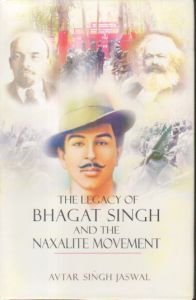
Contents: Introduction. I. Legacy of Bhagat Singh: 1. National freedom struggle and revolutionary currents. 2. Swadeshi movement to Kanpur Bolshevik conspiracy case. 3. The turning point. 4. Anarchism to socialism. 5. To make the deaf hear. 6. A courageous revolutionary and undisputed ideological leader. 7. A gaint-intellectual, Marxist thinker and dreamer of socialist society. II. The Naxalite movement: 8. Land relations: before and after the British rule. 9. The Tebhaga and Telengana peasant revolts. 10. The communist movement in India after transfer of power. 11. Land: crux of the problem. 12. The Naxalbari peasant uprising and formation of CPI (M-L). 13. After the spring Thunder. Appendices. Select bibliography. Index.
The first part of the book begins with brief introduction of the mainstreams and currents of the freedom movement of India. Next it moves on to the Swadeshi movement in Bengal, the emergence of the industrial working class in India, the first great War and its impact on the Indian economy and people, the start and failure of the non-violent, non-cooperation movement, spurt in the revolutionary activities and communal riots, formation of the Communist Party of India (CPI) and the Hindustan Republican Association (HRA), and the emergence of Bhagat Singh. The first part concludes with the life and times of Bhagat Singh his Party’s struggle against the British imperialism, his revolutionary socialist Marxist ideology to change the exploitative social system and to build society on radical socialist principles.
The second part includes the analytical study of land relations before and after the British colonial rule, the socio-economic crisis of the Indian poor peasantry after the introduction of Zamindari, Mahalwari and Ryotwari land systems, peasant struggles and uprisings against the new tyrannical systems, rebellions against the brutal exploitation and repression by the foreign rulers and their native lackeys, the development of the communist movement, the formation of All India Kisan Sabha (AIKS), the peasant radical struggles of Tebhaga and Telangana, India’s Independence, non implementation of land reforms programme, the Naxalbari uprising in the absence of land to the tiller the development of the Naxalite Movement in India in the last 45 years, the present scenario of the movement, with the political line of the CPI (ML) liberation and CPI (Maoist) (jacket)
