The Other Universe : An Anthology of Women’s Studies
Contents: Introduction/Aparna Bandyopadhyay. I. Textual/sexual politics: 1. From submission to transgression: a study of Tagore’s women in the short stories/Trayee Sinha. 2. The anti-feminist note in Tagore’s Raja/Madhumita Dutta. 3. Tale-transformations: happily ever after?/Kuntala Sengupta. 4. Enchanted or tangled Portrayal of women in popular fairy tales and the need for an alternate Canon/Sudeshna Chakravorty. 5. Home and beyond: the struggle of women in post-partition Bengal as portrayed by Narendranath Mitra/Madhumita Sen. 6. Prem Chand: glimpses of women characters in his short stories and novels/Shaheen Sultana. II. Writing her voice: eloquence and silence: 7. Women and literature: some female writers and female characters in Bengali literature/Siuli Sarkar. 8. Therigatha—a Hallmark in the quest for women’s liberation/Krishna Dasgupta. 9. Writing her voice: autobiography as expression of the self in nineteenth century Bengal/Anasuya Bhar. 10. Discourses of silence and the voices of Muslim women in colonial Bengal/Saika Hossain.11. Three guineas: Woolf’s concept of women, war and nation/Gargi Talapatra. 12. Voice of silence in Pratham pratisruit/Darshana Ghose. 13. Household and selfhood in colonial Bengal: contextualizing Saratkumari Deb’s Amar Sansar/Nandini Jana. 14. When a woman’s autobiography becomes a nation’s history/Riya Roy. 15. Memsahibs iun colonial India/Parna Ghose. 16. Mobile women and inter/national narratives : the case of Gertrude Hudson and Krishnabhabini Das/Purna Banerjee. 17. Under the blazing sun: lady Sahib, Emily Eden’s passage through India/Kakoli Sinha Ray. III. Historical perspectives: 18. Women’s education and empowerment: the Bengal scenario (from pre-colonial to colonal times)/Uttara Chakraborty. 19. Women in modern India: changing position and attitudes/Samita Sen. 20. Achievement and agony of Krishnabhabini Das: a social activist of the Nineteenth Century (1864-1919)/Gopa Datta. 21. Revisiting the women’s question in late colonial Bengal/Aparna Bandyopadhyay. 22. Women in Bengal legislature 1937-1957 : A survey/Bhaswati Chatterjee. IV. Performance and Films: 23. The inimitable Probha Devi: the Prima Donna of the new styled theatre of Bengal in the 1930s/Sarvani Gooptu. 24. Chokher Bali: A Journey from Tagore to Rituparno Ghosh/Paramita Chaudhuri. 25. Whose Icche or desire? Looking into the film Icche in the light of care ethics/Samanda Sen. 26. Imagining mother-India: critiquing bollywood’s construction of the cultural imagery of the nation-state/Surangama Guha. V. Politics and society: 27. Political realism: the gender way/Peu Ghosh. 28. Globalization and its impact on lifestyles of women: a study on women’s empowerment/Baisali Sinha. 29. Inequalities within: a curious case of a Diplomat, a maid and some queries on women’s rights/Subhalakshmi Pandey. 30. Being a fair bride and craving for a fair bride: reflections from the Bengali matrimonial columns/Aparnita Bhattacharjee. 31. Old women in India: experiences of living with their bodies/Sudarshana Sen. 32. Pursuit of body contouring: a choice or a compulsion?/Sumita Saha and Utkalika Saha. 33. Born to procreate: tracing the figuration of the maternal body in assisted reproductive technologies/Pinaki Roy. VI. Religion: 34. Gandhari the mother as reflected in the Mahabharata/Nandini Bhowmik. 35. Apala and Ghosa: two umarried women of the Rg-veda/Mau Das Gupta. 36. Women and Islam/Syeda Shariqatul Moula Alquadri. VII. Education and science: 37. Women’s higher education and self-reliance: personal reminiscences/Shefali Moitra. 38. Women in core sciences, technology and medicine: Bengal 1849-1949/Chandrakala Datta. 39. Tragedies of pioneering women scientists/Chhanda Basu Chaudhuri and Srabani Chakrabarty. VIII: Professional/Labouring women: 40. Women in police in India/Tumpa Mukherjee. 41. Maternity benefit in India/Mou Roy. 42. Impact of economic liberalization on gender wage inequality-a theoretical approach/Somasree Roychowdhury. 43. In favour of human rights: a qualitative approach to welfare of the informal women workers of India/Sreemoyee Ghosh. 44. Clay-based work in Kolkata with special reference to women workers: case study-Kumartuli/Payal Bose Biswas.45. For bed and board only: women and girl children domestic workers in post-partition Calcutta (reprint)/Ishita Chakravarty and Deepita Chakravarty. IX. Female sexuality: commodification, violence and justice: 46. The prostitution debate: gender politics, language and representation/Rongili Biswas. 47. Desired and condemned: the paradox of prostitution in ancient India/Sutapa Mukhopadhyay. 48. Female genital mutilation: violence, violation and feminist interventions/Trijita Gonsalves. 49. Sexual violence, consumer culture and feminist politics: rethinking the critique of commodification/Sreenanti Banerjee. 50. Capital punishment of chemical castration: the debate continues/Ranjita Biswas.
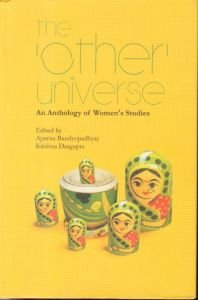
The Other Unvierse is an attempt to situate the Other the woman, ghettoized and invisibilized—at the very centre of scholarship and thus challenge the androcentrism pervading existing systems of knowledge. A collection of fifty essays, this volume mirrors path-breaking empirical findings and theoretical insights in the inter-disciplinary field of Women’s studies by contributors ranging from the stalwarts in this field to young scholars.
The book comprises nine sections each representing a long-standing or emergent arena of Women’s studies. While the much-researched main/male stream fields of knowledge like literature, history, sociology, political science, philosophy, economics, education and science are revisited through the gender lens, the volume also addresses newly burgeoning fields of feminist scholarship such as films, performance, travel and sexuality.
There is a remarkable degree of crossover with several contributors departing from their own disciplinary tracks and venturing into other domains of scholarship. The volume also addresses some of the pressing issues that concern the contemporary women’s movement, particularly, issues of violence and punitive justice.
Emblematic of the increasing diversification of feminist scholarship, and showcasing the best of inter-disciplinary research, the book is a must read for all who are engaged in Women’s Studies as students, teachers and researchers. It promises to equip the feminist activist with the much needed critical perspective and also draw the hitherto uninitiated to the field. It is a volume to be cherished by all.
