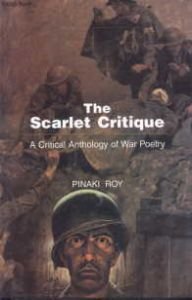
The Scarlet Critique : A Critical Anthology of War Poetry
Contents: Introduction. 1. A Brief History of the Anglo-American War, the Boer Wars, the First and Second World Wars and the Spanish Civil War. 2. War Poetry And It Characteristics. 3. An Overview of the Major British Poets of the First World War. 4. The Georgian Poets and Their Contributions. 5. An Assessment of Siegfried Sassoon and Wilfred Owen as War Poets.6. Effects of the First and Second World Wars on English Literature. 7. Post-Second World War British Poetry. 8. German War Poetry. 9. Francis Scott Key. 10. Alfred, Lord Tennyson. 11. William Butler Yeats. 12. Rudyard Kipling. 13. Laurence Binyon. 14. Stephen Crane. 15. John Mccare. 16. Edward Thomas. 17. Seigfried Sassoon. 18. Rupert Brooke. 19. Julian Grenfell. 20. Ivor Gurney. 21. Isaac Rosenbserg. 22. Wilfred Owen. 23. Robert Nichols. 24. Robert Graves. 25. Edmund Blunden. 26. Cecil Day Lewis. 27. Wystan Hugh Auden. 28. John Pudney. 29. Stephen Spender. 30. Henry Reed. 31. Dylan Thomas. 32. Alun Lewis. 33. James Kirkup. 34. Keith Douglas. 35. Sidney Keyes. 36. Philip Larkin. Appendix. Bibliography.
"The Scarlet Critique : A Critical Anthology of War Poetry seeks to reread select poems by twenty-eight different poets, many of whom served as soldiers particularly during the two World Wars. It aims to bring war literature nearer to the college and university students. Almost every university has war poetry on its syllabus in these days and the present work would prove useful for the students as it covers almost all the war poems generally included in the syllabi, with the critical analyses been offered in sampling language. Scholarly citations and quotations have been consciously avoided.
The scope of The Scarlet Critique is vast: it begins with poetry written during the Anglo-American War of 1812 and concludes with those written during the intense days of the Second World War actions. The author has tried to work out the anthology in such a way that no area covered by the more-read war poems is left untouched. Along with the poems, the poets’ biographies have also been offered so that readers can have an idea of the turbulent times in which the lines were composed or the mental agonies that gave birth to them. To the textual analyses, contextual information has been added to help the students with preparing essay-type questions.”(jacket)
