Transformation of Library Services in Electronic Era
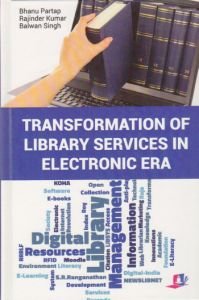
Contents: Preface. 1. Revolutionary changes in library services in IT era/Meghna Dhar. 2. Innovations in agricultural information system and services/Rabindra K. Mahapatra. 3. Transformation of libraries in electronic era/Balwan Singh. 4. Newspaper libraries network (NEWSLIBNET): a proposed model for resource sharing among newspaper libraries of North India/Parveen Kumar and Preeti Mahajan. 5. Impact of internet on extension specialists for farm advisory services: a case study of CCS Haryana agricultural University, Hisar/Bhanu Partap. 6. Challenges, opportunities and the role of librarian in technological era/Imran Khan. 7. Librarians and their conception in library and information science profession in current scenario/Ved Parkash, Somdutt and Mamta Kumari. 8. Scenario of library and information science education in South Asia with emphasis on India/Bobby Phuritsabam, Th. Purnima Devi and Memori Sagolsem. 9. Library and information science (LIS) education in ICT era: an Indian scenario/Srabani Karak. 10. Role of library professionals in digital environment/Shuvasish Sarkar. 11. Promoting the academic integrity through anti-plagiarism software: an overview/Santanu Das. 12. Web resources management and semantic web technology in libraries/Sruendra Kumar Pal and Nilratan Bhattacharjee. 13. Knowledge society: a changing dimension of LIS professionals and libraries in digital era/M. Muthu and V. Harineeswaran. 14. The technological university library management information system (MIS): a development strategy/Arun Kumar Sahu. 15. Digital library initiatives in academic libraries: a practical approach/N. Santhi. 16. Information literacy, e-literacy of the students of social science: a case study of school of social science, Assam University/Sumita Das and Susmita Das. 17. Role of library and library professionals: today and tomorrow/Mehar Singh. 18. National libraries in the continent of South Asia: a comparative study/Srabani Karak. 19. Application of Barcode technology in libraries/Lakhpat Singh and Mamta. 20. Public libraries in India: a historical perspective/Kiran Kathuria. 21. Awareness and use of E-learning portal by the undergraduate students of CCs HAU, Hisar: a survey/Rajinder Kumar. 22. KOHA-open source software for library management: an overview/Anil Kumar Jharotia…..
Today’s era is known as Information and Communication Technology era. Every aspect of human life is affected by ICT. The applications of Information and Communication Technology (ICT) in libraries have brought the revolutionary changes in the entire concept of library operations, services and management. Today, the modern libraries are not equipped with print books and journals but also with CD-ROM Databases, digital Video discs, Electronic databases, consortia’s, e-books and e-journals etc. Hence libraries have been transformed from traditional libraries to hybrid libraries having print, electronic and online resources. So, the library and information science professionals used to get ready to face the challenges emerging due to the adoption of newer technologies. An attempt has been made in the present volume to synthesize all aspects of library and information science and ICT and to put them in the systematic order at one place to understand the conceptual phenomena and to render the better and effective services to the patterns. This book not only deals with the theoretical aspects on different topics, but there are also some case studies which show the path to march forward. The emergence of internet as a new media of information delivery, digitization, innovations in agricultural information system, plagiarism, farm advisory services, RFID, Barcode technology, KOHA, Moodle, etc., have been discussed in one way or the other in the proposed book. The book is suppose to be useful for practicing librarians, information scientists, information managers, research scholars, students and teachers of library and information science and others who are concerned with information science, modernization and digitization of library and information resources and services.
