UDC A Manual for Classification Practical and Information Resources
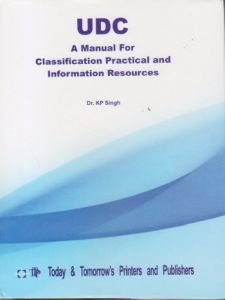
Contents: Preface. I. Content framework: 1. Basic of library classification and universal decimal classification. 2. Depth schedule of common auxiliary of Indian states and places. 3. Computer science and technology. 4. Management. 5. Librarianship. 6. Philosophy. 7. Psychology. 8. Religion and theology. 9. Statistics and statistical theory. 10. Sociology. 11. Politics. 12. Economics. 13. Law. 14. Public administration. 15. Safe guarding the mental and material necessities of life including: social work social aid housing and insurance. 16. Education. 17. Cultural anthropology, ethnography, customs, manners, traditions and way of life. 18. Environmental science. 19. Mathematics. 20. Astronomy, astrophysics space research and geodesy. 21. Physics. 22. Chemistry. 23. Geology and earth sciences. 24. Biology. 25. Botany. 26. Zoology. 27. Biotechnology. 28. Medical science. 29. Engineering, technology in general. 30. Agriculture and related sciences and techniques. 31. Home economics domestic science and housekeeping. 32. Communication and transport industries accountancy, business management and public relations. 33. Chemical engineering, chemical and related industries. 34. Architecture. 35. Photography. 36. Music. 37. Recreation, entertainment, games and sports. 38. Linguistics and languages. 39. Literature. 40. Geography. 41. History. Index. Librarianship has been in existence ever since the progression of the human society and developed with the growth of institutions throughout the world. The primary objective of librarianship aims towards the selection, acquisition, process, evaluation, storage and dissemination of selective knowledge contained in books, periodicals magazines, encyclopedia, dictionaries, directories, computer files, CDs, DVD, Pen drives ad the internet. Essential resources must be properly organized in libraries for the purpose of effective use and retrieval. Hence the role of library classification came into the existence. Library classification is a system intended for organizing all forms of literature in a systematic order using the globally accepted notational system. The library classification in spite of far-reaching alterations in the presented day scenario remains the focal point in libraries and teaching schools throughout the world for organizing the thought content and retrieval of the information recorded in documentary and non documentary forms in the most mechanical way. UDC or Universal Decimal Classification is the most popular and widely used classification scheme not only in India rather throughout the world, particularly in the libraries of science and technology.
