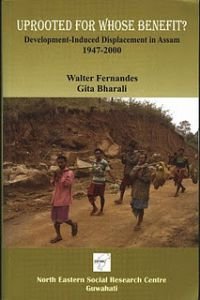
Uprooted For Whose Benefit : Development Induced Displacement in Assam 1947-2000
Singur and Nandigram marked not just a watershed moment in deciding the political fortunes of the TMC and Left Front Government in West Bengal by catapulting Mamata Bannerjee as the didi of the masses, ripping off, not in the least unceremoniously, what was essentially a leftist ideal and making it her own. It also jolted the comfortably complacent urban middle class from his blissful ignorance and made the average Indian family familiar with issues of displacement, rehabilitation, resettlement etc. It is no wonder then, that policy framers in New Delhi are sitting up and taking note of how the dispossessed marginal can shape political destinies. The Land Acquisition Act (LAA), 1894, a colonial legacy, is no doubt outdated. With the draft land acquisition bill to go public in a few days, one can be assured that the raging debate will continue.
The book is first among an NESRC initiative on a series on displacement studies. The study looks at the extent of post-independent displacement and deprivation in the state by development projects from 1947 to 2000. Completed in 2006 and published in Assamese in 2007, lack of funding delayed its English translation. Nevertheless, it couldn’t have come out at a better time.
The first chapter as an introduction calls the study, a ‘story of the losers’ – the narrative of the dispossessed coming to the fore. Initially one maybe overwhelmed by the numbers and statistics but that makes it credible. Conscientious effort of the researchers to arrive at a conservative estimate of the number of people who are deprived of livelihood without physical relocation (PAPs) as well as displaced people (DPs), in the face of inadequate data and official records, is commendable.
